
Who Should You Sell To? The Truth About Customer Fit and 'Sales Debt'
Most companies don’t struggle because they can’t sell.
They struggle because they sell to the wrong customers.
It starts innocently enough.
A “yes” that feels like momentum.
A customer who sort of fits.
Revenue you can’t say no to.
But over time, the costs add up: customer churn, support overload, product detours. Slowly, the business bends around customers it was never meant to serve.
That hidden cost has a name: sales debt.
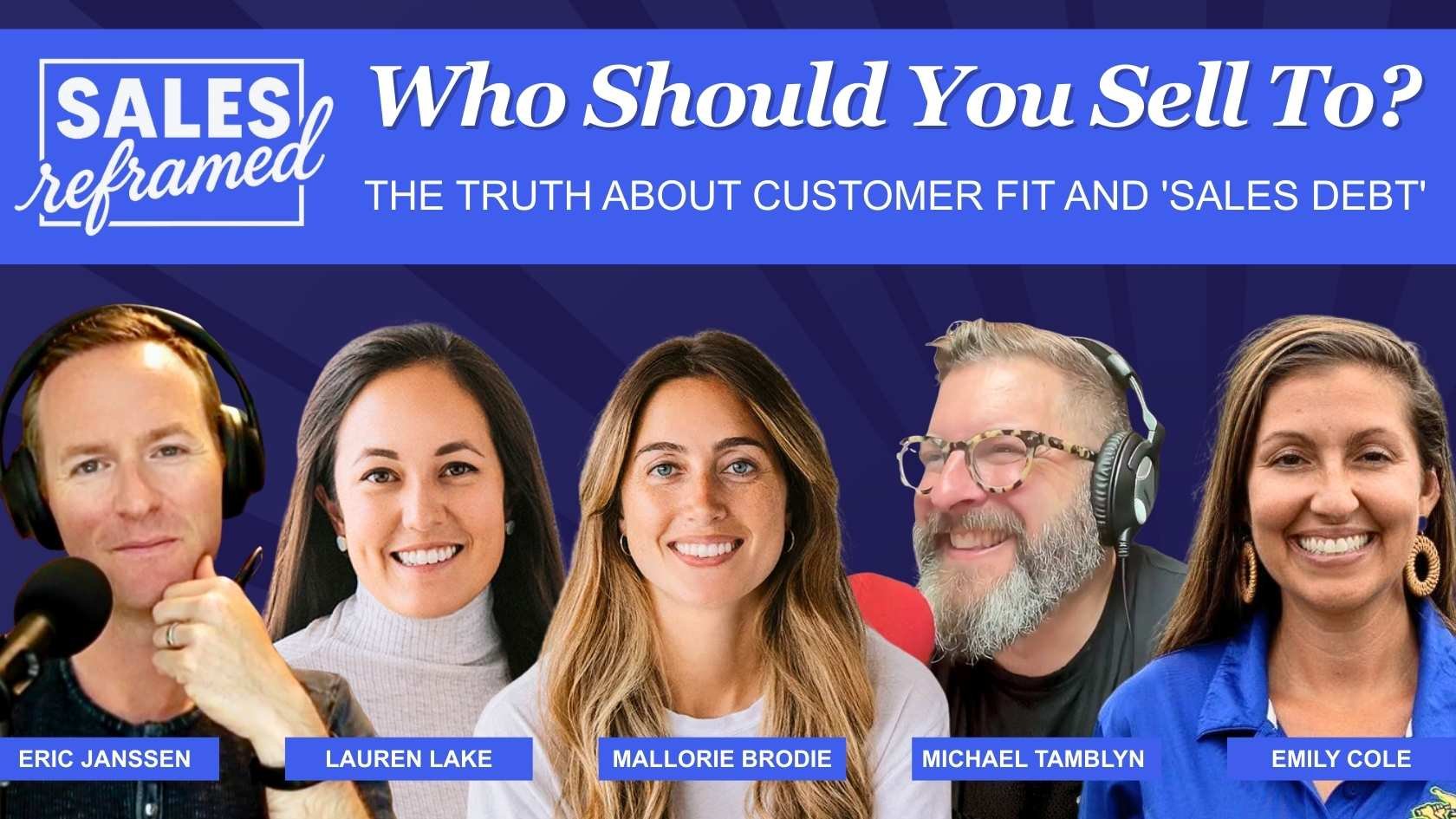
In this episode of Sales Reframed, host Eric Janssen explores what it really takes to understand your customer and why clarity about who you’re for changes everything.
Because across industries, the same pattern keeps showing up: customer fit isn’t luck. It’s learned.
You’ll hear from Emily Cole of the Savannah Bananas, who helped build a fan-first sports phenomenon—with highlights featured on SportsCenter and a ticket waitlist nearing a million—by putting fans first…
from Lauren Lake and Mallorie Brodie of Bridgit, who found product-market fit through 500 coffee-and-donut conversations and turned those insights into a $35M-backed company…
and from Michael Tamblyn of Rakuten Kobo, who scaled a global reading platform and gained a new perspective after a call with an 80-year-old customer…
Different worlds. Same lesson.
When you truly understand your customer, everything gets easier: who to pursue, what to say in your pitch, and when to walk away.
Because most companies don’t starve from lack of opportunity.
They drown from lack of focus. And focus starts with knowing exactly who you should be selling to.
Reframe Takeaway
After listening, you’ll see that sales isn’t just about how you sell – it’s about who you choose to sell to. When you slow down, get curious, and learn from the customers who already value what you do, clarity follows. You stop chasing every opportunity, avoid costly sales debt, and start focusing your time and energy where it actually compounds. Because the right customers don’t just buy, they help you build a better business.
Episode Guests
Emily Cole: Co-Owner (and the “Director of Fun”) of Fans First Entertainment and the Savannah Bananas.
Lauren Lake: Co-Founder of Bridgit.
Mallorie Brodie: Co-Founder of Bridgit.
Michael Tamblyn: CEO of Rakuten Kobo.
Top Episode Learnings
Your Best Customers Can Be Your Best Teachers
Customer positioning comes from real conversations. The fastest path to clarity is often the simplest one: talk to the people who already chose you. Their insights, priorities, and outcomes naturally point you toward your real value and your best next opportunities.Sales Debt Adds Up Over Time
Short-term wins with poor-fit customers can feel like progress, but they often create long-term drag—higher churn, heavier support needs, and product decisions shaped by the wrong voices. Early customer exploration is healthy, but sustainable growth comes from focusing on the customers who truly fit.Customer Fit Clarifies the Path Forward
Most companies don’t starve from lack of demand—they drown in too many directions. When you’re clear about who you’re for, everything gets simpler: your messaging sharpens, your pipeline tightens, and your roadmap gets clearer. The strongest teams aren’t the ones selling to everyone. They’re the ones who know exactly where they fit and aren’t afraid to walk away from the wrong customers.
Resources Mentioned in This Episode
Case Example: Intellitix and The International – Customer-fit lesson in esports: asked why the customer bought and used the answer to target similar high-fit events.
Publication: “The Risks of Prioritizing Short-Term Revenue Over Customer Fit” by Eric Janssen, Brian Denenberg and Benson P. Shapiro in the Harvard Business Review.
Case Example: The Savannah Bananas and Fans First Entertainment – A fan-first baseball entertainment organization that redesigned the live sports experience of traditional baseball.
Case Example: Bridgit – Construction workforce planning software company founded by Lauren Lake and Mallorie Brodie, built through extensive on-site customer discovery with contractors and project managers.
Case Example:Rakuten Kobo and Indigo Books & Music – Canadian bookseller and e-reader platform that partnered to adapt to digital disruption in bookselling.
Transcript
[MUSIC PLAYING]
ERIC JANSSEN: Picture a classic scene from any movie or TV show about old school advertising. A group of ad execs sitting around a conference table. Empty pizza boxes stacked high. If it's Mad Men, ashtrays spilling over. If it's anything past Mad Men, maybe a growing pile of Red Bull cans. There's a whiteboard. And the best and brightest minds at the firm are trying to come up with the perfect pitch. The one that's going to land the white whale, the ultimate client.
Well, my friends, this is the very scene I found myself in a few years ago with my team at Intalytics. We provided RFID wristbands and the tech platform that powered major music festivals like Coachella, Tomorrowland, and Lollapalooza. And we'd spotted a new growth opportunity in the esports industry.
Live esports tournaments were getting bigger and bigger and attracting tens of thousands of people to their tournaments. And we thought our tech could help. We'd just signed the International, one of the biggest tournaments in the space, and we're eager to keep that momentum going.
So I lock the team in a conference room, ordered the pizza, and passed out the Red Bull. What's our messaging going to be? How do we attract the next big client? What can we do to position ourselves properly? We kept brainstorming and whiteboarding and hours passed by. And honestly, it felt like we weren't getting very far until one of my extremely bright interns piped up and said, why don't we just ask the first tournament why they decided to work with us in the first place? And it was like, duh! Of course that's the answer.
Why on Earth are we locking ourselves in this room, literally shutting ourselves off from the outside world and the one customer that we actually have? Of course, we're not going to come up with the answer that way. So we literally called them and asked, why did you choose to work with us? What they said changed everything. You're a platform that allows us to continuously enhance the customer experience year after year.
And when we pushed a little deeper, why did that actually matter to them? It came down to the data and sponsorship dollars. The fan experience was the product, but the data we captured let them prove value to their sponsors, which turned our platform from a cost center to a revenue generator. That changed everything for us. We weren't just selling tech to events. We were selling a way for them to make more money and improve the guest experience.
And once we understood that, we knew exactly who else to go after and what the pitch should be. Not every esport tournament was a fit, but the ones with real sponsor relationships who were hungry for data and wanted to improve ROI. those were our people. I don't know why so many of us default to this, but there's an assumption that we're supposed to figure everything out on our own. But in sales, that instinct can be dangerous because your best customers are often your best teachers.
Yes, there's a place for internal work, reviewing the numbers, analyzing trends, and forecasting. But there's also enormous value in getting outside of the conference room and talking to the people who already chose to work with you. So this week we're talking about the customer and why understanding who they are, what they need, and why they're a great fit for what you're selling, is fundamental to sales success, because who you choose to sell to and how well you understand them, might be the most important decision a company can make.
I'm Eric Janssen, an entrepreneur turned sales professor. And I have a simple mission to change the way people think about sales, because sales is a life skill. And this is Sales Reframed, a podcast brought to you in partnership with Ivey Executive Education.
In software development, there's a concept called technical debt. It's the future cost of shipping imperfect code, the difficulty of building good code on top of bad code. I recently co-wrote a piece for Harvard Business Review that applies this same concept to sales. Sales data is what accumulates when you sell to customers who aren't a great fit, chasing short term revenue at the expense of long term growth. These poor fit customers churn faster and pull your product team in directions that don't serve your best customers.
Now, some sales debt is inevitable. In the early days, you don't know exactly who your ideal customer is, so you cast a really wide net and just learn as you go. That's actually healthy. But at some point you have to step back and ask, are the customers we're working with the kind that we should be building the future of this company around? That's the shift from exploration to intention.
And it's why understanding your customer, really understanding them is so fundamental. Because most companies I see don't starve from a lack of opportunity. They drown from a lack of focus. So today we're talking about knowing your customer. Let's get into it.
If you want to know what drives the Savannah Bananas, you don't have to look much further than the name of their parent company, Fans First Entertainment.
EMILY COLE: We just started very clearly with our mission. With the company's name being Fans First, our mission is fans first, entertain always. So we are either putting the fan first and taking care of them in some capacity, or we are entertaining them. Those are our parameters.
ERIC JANSSEN: That's Emily Cole, one of the co-founders of Fans First, and one half of the couple that's created the sports phenomenon known as Banana Ball.
EMILY COLE: We found that baseball was long and slow and boring for those of us who already worked in the industry, and my husband who played. And he's like, if I'm bored, how are these people sitting in the stands for four hours? We created Banana Ball to make baseball fun, and that's what we are. We're a very fast paced, entertaining sport. A lot of trick plays, a lot of acrobatics, but it is still, at its root, a very competitive game between two teams.
ERIC JANSSEN: If you've never seen Banana Ball being played, imagine baseball with the amped up theatrics of the Harlem Globetrotters or pro wrestling, but without the scripted outcomes. There are antics, dance routines, fan participation, all of it. But the games are competitive and both teams are really trying to win. These days, the Bananas highlights are shown on SportsCenter, and they have more followers on TikTok than the official Major League Baseball account. And waitlists for tickets is around a million people long.
But back in 2016, the Bananas were a new team in a regional Summer League that you've probably never heard of. Emily and her husband, Jesse Cole, met in 2010, working for a different minor league team. They fell in love and eventually settled in Savannah, Georgia. The city's minor league team had moved to South Carolina, and that left an empty stadium looking for a team. Enter Emily and Jesse.
EMILY COLE: Here we are, outsiders, or we're young. At the time, we're in our mid 20s. And nobody's taking us seriously. We sold, like, two season tickets. Nobody was buying tickets. Everyone thought we were a joke. We honestly received hate mail once we named the team The Bananas. But that was the turning point for us was, how do we convince them that we are different? And so we went all in on being different. We named the team the Savannah Bananas. We named our team after a fruit. We really wanted to go all in on this entertainment, fun, different community type feel.
ERIC JANSSEN: Emily and Jesse's hope was that if the two of them, two people who lived and breathed baseball, were looking for something a little different, a game that was faster paced, less caught up in rules and tradition, and most of all, more fun to watch than maybe they'd be able to find a few thousand like minded folks in Savannah.
EMILY COLE: So we probably had our first game in May. Somehow, by some miracle, we were able to convince enough people to come to sell the game out, which was like 4,000 people at this time in our small stadium in Savannah, Georgia. But we sold enough tickets to fill the stadium. I honestly think most people bought the tickets because they thought they were going to come to a joke or a failure, or they were going to be there to be able to post about it later.
But fortunately, the whole offseason we had been perfecting our craft and the name of our company is Fans First Entertainment. We went all in on working on the show, working on how we were going to entertain, how we were going to take care of our fans when they showed up.
And although, it was a complete downpour that first night and it could have been a horrible night, we had-- I don't like the word trained because that's usually used towards animals, but we had gone through enough orientations with our people and we had taught them enough and shared with them enough the passion and the vision that when it started raining, everybody went and grabbed umbrellas or tarps or something and walked people from their cars into the stadium.
I mean, this had never been done before. There were players doing this before. Fans are out in the rain in their car coming to watch us, hopefully fall on our faces. And that first impression is that we let them into the stadium early by escorting them in because it was raining. So right off the bat, we started winning people over because of our heart and because of how much we cared about them and about this product.
Then they get into the stadium and although, it's raining for two hours, we had planned to have a rain delay script. We said, OK, if there's no baseball, how can we entertain these people? How can we take care of them? So we have three hour-- two or three hour rain delay script where our players are doing tarp slides and our dance team, which are a bunch of grandmas, they're called the Banana Nanas. They went up on the dugouts and they danced during this time.
And so even though people did not end up seeing one pitch thrown that night, the whole game ended up being canceled, People left entertained and they left saying, OK, I understand what this is about. Maybe I'll go see them again. I'm not saying they were won over right away, but we at least had 4,000 people who wanted to give us a chance and who were rooting for us.
ERIC JANSSEN: So how did Emily and Jesse know what to do to bring in 4,000 fans on that very first night? They didn't have to guess because they were the customer. They were the baseball fans looking for something different. Remember what Emily said?
EMILY COLE: If I'm bored, how are these people sitting in the stands for four hours?
ERIC JANSSEN: And that drive to do things differently, to always put the fans first, has led to some incredible success. You've grown significantly specifically over the last couple of years. Can you give us a frame of reference for size scale? You know, you're doing a world tour, just like, how big is this thing now?
EMILY COLE: It's obviously much bigger than we ever anticipated. We started as a college summer wood bat league team. And for those of you who are not familiar with baseball, that's a pretty low level of baseball. OK, so we were having guys come who were, you know, maybe playing division 1 baseball, but they wanted to be seen by scouts during the summer. They wanted to keep their reps up so they would come play for us for the summer. And it was a league that didn't really matter, OK.
And now what it has turned into is its own sport. You know, we actually left the league that we were in, which was an actual baseball league. And we created an entirely new identity of a new sport. So we do not play baseball anymore. We actually play Banana Ball. So we created new rules and have a new league and have our own teams. And now we travel all over. We call it the world because that's where we're anticipating.
But right now we're still just across the country, across the United States. And yeah, we play all over from about February to October. The things that I was working on before I got on this call was our crews. We've actually chartered a cruise ship. And so in October, we are taking 2,500 of our biggest fans who have bought cabins on this exclusive Banana Island at Sea cruise. So it is growing into things that we never anticipated, you know, nine years ago when we started.
ERIC JANSSEN: It probably certainly wouldn't have anticipated in 2008 when you graduated and had no idea how this was going to play out, right?
EMILY COLE: Correct. I mean, that's the beauty of following your passions. I didn't wake up when I was 12 and say, this is what I want to do. But you just take different opportunities that come and you get your hands dirty and you start interning or taking part time jobs and finding out what you like. And here I am.
ERIC JANSSEN: Sometimes to know the customer, you have to live in that world. But this isn't the only way. You don't have to be born and raised in an industry to become a savvy salesperson. Emily and Jesse were their ideal customer. But what if you're not? Sometimes the solution is to immerse yourself. And my next guests are a fantastic example of doing just that.
MALLORIE BRODIE: Yep, so my grandfather had a demolition company, great grandfather had a steel company. And then Lauren's family, her grandfather as well had a specialty trade contractors. So we both grew up at least knowing about the industry, and then Lauren had some onsite experience as well as the degree in civil engineering.
ERIC JANSSEN: That's Mallorie Brodie. She and her co-founder, Lauren Lake, built Bridgit, a workforce planning platform that helps construction companies put the right people on the right projects at the right time. Today, nearly 40% of the top contractors in North America use it. What's remarkable is that neither Mallorie nor Lauren came from the construction or software industries. They learned about them from the ground up, one conversation at a time. Both had family who'd worked in the trades, and Lauren had a civil engineering degree that gave her some exposure to how job sites operated. But peripheral familiarity isn't the same as really knowing an industry. Here's Lauren.
LAUREN LAKE: Yeah, so I had spent a little bit of time onsite, like literally just as a co-op student. And so I had just seen kind of how the site operated. I spent time working with different sites and just understanding that there was very little technology that was being used. So when Mallorie and I started talking, that's kind of where the conversation started, was just around, you know, isn't it odd that everybody has a cell phone, smartphone with them at all times, yet everyone's using pen and paper onsite.
And it was really just quick Google searches at that point. We realized we had this shared family background that was interesting, and we started calling all of the friends and family we could, just asking them what their experience in the industry was. So just trying to reach out to people we knew had some construction experience and asking them what they felt the challenges were. It got us on that path of thinking about mobile technology and why it wasn't being used on the job site at that time.
And so that's what led us to doing our true onsite research that lasted the next six months, where we just drove around to construction sites and talked to people and tried to get their perspective and their understanding and realized that really wasn't true. People onsite really wanted to leverage technology. They just didn't feel like they had the tools that they needed.
ERIC JANSSEN: What did you show up onsite with? Did-- just talking, did you?
LAUREN LAKE: Donuts.
ERIC JANSSEN: Donuts, OK, so you had food, OK. So how did that go? Like, what would your first meeting go like to get feedback onsite for this idea?
MALLORIE BRODIE: Yeah, so we got back to the Western campus, and it was actually when the new Ivey building was under construction and just a block away from where Lauren was living at the time. So we basically walked on the site with coffee and donuts and we said, hey, can we have 10 minutes of your time. We're students and we're doing research on a project.
And they said, OK, sure, sounds good. We have 5 or 10 minutes for you. And we just started asking, you know, what's challenging for you onsite? What's frustrating? What takes too much time? What costs a lot of money? And that was the first of many, many interviews that we did. And the Ivey building, we actually ended up shadowing them many, many morning on site.
So we would just come back and follow them around, watch what they were doing, you know, look at all the paperwork they had on their site office. And it was this site that was the first one that talked to us about the punch list management process or deficiency management. And that's kind of what prompted us to actually start designing the app and what it should look like and how it should work.
ERIC JANSSEN: Cool. So they literally like, just let you follow them around and watch them and see how they put information in their computers or not computers.
MALLORIE BRODIE: Yeah, I think the reason they allowed us to keep coming back was because every time we came back, we had donuts and coffee, but we also had made progress. I think it built confidence that we were serious about this.
LAUREN LAKE: We ended up doing that over 500 times over those six months.
ERIC JANSSEN: 500 meetings?
LAUREN LAKE: 500, yes.
ERIC JANSSEN: Wow. You heard that right 500 meetings. But I think that points to a really smart decision that Mallorie and Lauren made. Rather than trying to create an everything app that solved every problem and provided a one stop solution for every possible job site under the sun, they drilled down on a few very specific solvable problems that seem to affect general contractors, and that guidance came from people on the ground, the actual end users of the thing they were building.
MALLORIE BRODIE: And so even now, when we're thinking about product development, and we're a 45 person company now, we don't have these debates in the boardroom about what we should build. We go out and we talk to the customers because they're ultimately the ones who can best describe what their pain points are. So when you're really about to actually invest in something, making sure that you're genuinely interested and curious about what your customer's pain points may be, as opposed to seeing it as this step that you just have to do to check off a box.
LAUREN LAKE: It wasn't from day one, like we were doing these really focused surveys. It was very broad questions like what Mallorie said, you know, what's the biggest frustration in your day. And every interview would go a different direction. And it was challenging at that time to figure out what the focus point for us should be, because there were endless opportunities we found within the construction industry. And so we had to be really careful that we weren't trying to go too wide too quickly. We knew that it was just the two of us. We had limited money at that time, so we really wanted to pick something super focused and do a good job of that before just trying to do everything.
ERIC JANSSEN: Their next step was to get a working beta version of Bridgit into the hands of their early adopters, with the hope that these early users would then become actual customers.
MALLORIE BRODIE: I think that's another reason why that the research is valuable is because it essentially becomes your sales pipeline when you actually launch the product. So all of a sudden you have 500 people that have been engaged in this process that could become your customer very quickly, as opposed to starting just from scratch. So, yeah, a bunch of them did become customers.
[MUSIC PLAYING]
ERIC JANSSEN: To date, Bridgit has raised over $35 million in venture financing and touts a long list of top tier customers. Not bad for two founders who showed up to construction sites with donuts and no industry experience. I think people sometimes get caught up in the idea that sales is about luck or vibes or intuition. Maybe it's all about who you know. And sure, that might help you get a foot in the door or land a first meeting. But once you're in the room, you have to actually know who you're selling to. You can't just vibe that out.
So far, we've heard two startups use deep customer understanding to build successful businesses. But this isn't just a startup story. The same principle holds for big, more established players facing massive disruption. Take bookselling, over the past two decades, the industry has been upended on every level, how books are sold, how they're distributed, and how they're read. Most legacy players didn't survive the shift, but a few managed to navigate it and come out stronger. One of them, the Canadian chain Indigo, and its e-reader spin off, Rakuten Kobo
MICHAEL TAMBLYN: 2006, 2007, you see a bunch of different e-readers show up. There was a company called E Ink that had figured out how to make these low power non-reflective screens that were getting closer to what paper would look like, as opposed to an, you know, an OLED screen or an LCD screen. And a bunch of companies jumped on that early and started making what would become the e-reader industry.
ERIC JANSSEN: That's Michael Tamblyn. He's the president and CEO of Rakuten Kobo and has been with the company since day one in 2009. Before that, he was the founding CEO of the supply chain agency Booknet Canada and co-founder of Canada's first online bookstore, Bookshelf.ca which later became Indigo.ca. Oh, and not to brag, but he's also a Western grad.
MICHAEL TAMBLYN: Sony was one of the first ones. Amazon came in pretty quickly after that as well. So we're looking at 2006, 2007, 2008. And it was around that time that my old friends at Indigo were getting together around a table and starting to have a strategic conversation about what would happen if ebooks started to displace print books. We were in the course of seeing the disruption in the video and DVD industry.
You could argue about the nature and the shape of that disruption, but the one thing that was absolutely clear was that the biggest casualties were the retailers, the people that had that endpoint connection with the customer, and that was a situation that Indigo was taking really seriously. Disruption is coming. Are we going to disrupt ourselves, or are we going to let somebody else do it to us? And to their credit, they were like, yes, let's do it to ourselves. And they hired a bunch of people to start working in the Indigo basement on what it would mean to have an ebook offering connected to a bookstore.
ERIC JANSSEN: To get a sense of the position they were in, an e-reader company actually has three different sets of customers, all with varying needs that have to be met, publishers, bookstores, and readers. And to survive, Kobo would need to present a winning pitch to all three of them. I'll let Michael explain it.
MICHAEL TAMBLYN: When we started in the ebook business, there must have been like 50, 60 startups that were all working around in this space. And now there's us, a couple of others that are more regional players, and then the biggest e-commerce company in the world, the most profitable hardware manufacturer in the world, and the biggest search and ad platform in the world.
In each of those three cases, they have privileged access to a base of customers that they get to pull on. So if you're Amazon, you get to take all of the book customers that you've amassed around the world. You get to introduce them to ebooks, and you get to move some of them to digital. Like, that's your customer funnel.
If you are Apple, you're going to sell a billion phones and you're going to put an ebook app on all of them. That's Google Books. And some number of people are going to bump into that and become ebook customers for you. Same with Google. You're going to have the Google Play store. It's going to show up on five billion Android phones. Some number of people are going to bump into that and start using it.
And the one thing that none of those three big companies could do was create a win-win partnership with a book retailer who already had great relationships with a lot of the book consumers in a particular country. And so going to that place where our competitors couldn't go, finding a value proposition that was going to help accelerate our business but also solve a major strategic dilemma for them, ended up kind of being the only viable solution to the challenge of how else can you be a global ebook platform that doesn't involve being one of the big three tech platforms?
In the beginning, I was working. How do we get publishers to give us ebooks. What does our content catalog look like? Can we get the rights to sell these books all over the world? And then also the e-commerce part, how are we going to sell them? How are we going to price them? What's our promotional strategy look like?
And we had a couple of foundational ideas when we were starting up the company. And one of them was that the ebook market wasn't going to be like the physical book market. And in physical books, you have the biggest bookstore in Canada, and you have the biggest bookstore in France, and you have the biggest bookstore in the UK. And we can already see from the complexity of the solution and the amount of investment that was involved that there wasn't going to be one of these for every country. There was going to be a few of them, and they were going to span the world, and we thought that we had a pretty good chance that being one of them.
ERIC JANSSEN: As a salesperson, when you're a hammer, everything's a nail. So now I'm hearing you're in these early meetings with publishers trying to-- I don't love using the word convince as a salesperson, because I don't think you're trying to convince them to do something that they don't want to do, but you've got to somehow show them that there's this change happening, that you see the world a certain way and then bring them on board with you. Take us to those earliest pitch meetings, whether it's a new market that you had to expand to or even the publishers in Canada.
MICHAEL TAMBLYN: Again, the conversations that had to happen in a couple of different directions. We had to get the publishers on board, and that was in some cases deeply challenging, because it wasn't just that publishers were seeing this as a format shift. There's a lot of emotion around the physical format of the book in a way that I think there wasn't with music, for example.
Like, you know, there was-- you know, people have strong attachment to vinyl, but they made that shift to CDs. You know, digital might be another format shift. That wasn't the part they were worried about. What they were worried about was piracy and the change in distribution. And like, those are the things that they were worried about.
And by the time we got to book publishers, they had seen the music industry completely be turned upside down. They'd seen video in the process of being disrupted and reimagined, and the combination of conservatism about the format on one side and full on fear of disruption on the other was really strong.
The good thing about all of that a lot of the fear was directed in a particular way. Publishers were worried about Amazon. They were worried about a single company dominating this format. They'd gotten it with Kindle early. They were doing a lot of very aggressive repricing of books and ebooks. They were selling books that were selling in hardcover for $25, $27, $30 for $9.99. They were losing money on every book, and it was very clearly a push to secure as much of the market share in this space as they could before other companies could get started.
So in some ways, the fear of one company dominating the space was a huge advantage for us because what they were looking for was competition. They wanted other people to come in and create a more diverse market, and fear is a powerful motivator to make change in some ways easier than trying to frame the opportunity. Our bias always is that we overestimate our ability to accurately forecast risk, and we underestimate-- like we're not as good at figuring out what opportunity actually looks like.
So if we're trying to get somebody to move and to try something new, getting them to understand the risk of not doing it is some ways a lot easier. And that was certainly the case for us. You know, you want to work with Kobo because you need somebody else in here that initially wasn't Amazon and then later also wasn't Apple and wasn't Google. Like, you want somebody who actually cares about this segment as an industry for its own sake. That ended up being very powerful.
ERIC JANSSEN: So publishers want to see more competition, but retailers that might be a substantially harder pitch. It's a group of folks who would most likely, initially, at least, see them as a direct threat.
MICHAEL TAMBLYN: The other set of conversations we had to have, though, was with other retailers. We had figured out fairly early on that the strategic dilemma that Indigo was facing was a replicable one. They were trying to answer the question, how do we, as a national book chain, solve the question of how to sell ebooks? There are a lot of national book chains.
So that became a model that we could take and walk from country to country and find that number one or number two retailer in a territory who was absolutely facing that same strategic dilemma that Indigo was. And if it wasn't coming at them like right now in front of them, they could see that it was only a few years away. We were able to say, hey, there's a way that you can meet this moment and we can help you do it.
And not only can we help you do it, we've already helped other people do it. And they're retailers that, you know, and they're in the same industry that you're in, and you can talk to them and you can find out that it's going to be OK. And our job is going to be to make sure that you're as competitive as possible in the face of this challenge that's coming at you. And that ended up being a really compelling proposition as well.
ERIC JANSSEN: Part of the job that we're trying to do here with the podcast is to reframe the way that people think about selling, because we have this idea that it's a salesperson versus a buyer, that you're trying to convince them to do something, that there's magic words that I can say that are going to get them to close, you know, at the very end. It's not at all the type of selling that we're talking about in the podcast. This is a great example because this is-- there's this change happening in the world. We see a path to be able to help you. Let's get aligned in solving this problem together as partners. That feels like a perfect example of the type of selling that we want to teach.
MICHAEL TAMBLYN: We both needed something. So it wasn't just a case of, I've got this product and I want you to buy it. What we had figured out was that the most valuable customers that we were looking for were already attached to bookstores. They already had a relationship with someone. It was going to be very expensive for us to introduce ourselves to book consumers in different countries and convince them that we were a good place to go to all by ourselves.
At one point, we had an estimate that for the US, for example, it was going to cost about $20 million worth of marketing for each point, each percentage of market share that we wanted to acquire there. So a 10 point share, $200 million of marketing. And 10 points, it's not a lot. So we needed another way to find customers. The way that we came to was if we can create these partnerships with book retailers, we have what they want.
They want a compelling solution to the ebook problem. They want to be absolutely a peer competitor to companies like Amazon that are coming into their space and actively want to try and take their customers. And instead, we can work together. We can create a great solution. Customers are going to be happy, and you're going to be able to keep that relationship with them over time, rather than having them scooped up and taken to another e-commerce ecosystem somewhere else. And that ended up being a really compelling model.
ERIC JANSSEN: OK, so publishers check, retailers also check. The last piece of the puzzle was making a compelling pitch to end users, the readers themselves. The starting point is obvious, portability, the appeal of new technology. But it took a few stumbles before Kobo really began to understand their customers. It actually took a few years for them to reassess not only how they were selling, but also to who.
MICHAEL TAMBLYN: So it wasn't until probably almost four or five years in that we start getting disciplined about understanding who this customer is, why have they come to us, what are the different kinds of customer problems that we're solving, and how can we look at those in a more deliberate way in order to get a sense of, of where we should be going next.
The first kind of glimmer of this for me, where maybe we're not where we think we are, because when you start a company, you build products for yourself in a lot of ways. The easiest person to ask about what should we do next is you. You're right there all the time. And so you had a whole bunch of people in their 20s and 30s. And so you're really building products that resonate really well for people in their 20s and 30s. And it took a while for us to say, OK, well, that's us, but who's out there actually using this?
And one of the first times that penny dropped for me was I got a phone call from a customer. And there was, you know, there was kind of a period where I had customer service reporting up to me. We had, you know, messed up a charge on a customer's credit card. And they were angry and they wanted someone to talk to. And, like a salmon swimming upstream, you know, this man had escalated from manager to manager to manager until he finally got to me.
And after he finished giving me a piece of his mind, which was totally fair. After that, we get to talking. And this is clearly an older adult, and so I'm asking him about who he is and how he got to Kobo. And he was 80 years old. And he had just started reading again. He had been a lifelong reader and had loved books all his life, and then had stopped reading at 70 years old, had macular degeneration, you know, very common things that happen to people as we age, to the point where even large print books weren't big enough for him to be able to read anymore.
So for 10 years, he had not been able to do the thing that he loved the most, which was reading books. And then at 80, his 60-year-old son had given him an e-reader. And finally he had a thing where he could make the print the size that it wanted to be so he could start reading again. So he was back reading in his 80s after a 10 year hiatus. The data points that jump out as I'm having this conversation, a, we have 80-year-old customers and probably more than one.
Second, they're being equipped by their 60-year-old children, and that people are using ebooks not just for the sake of their portability or because they're interesting technology. They're using them as a way to overcome a reading barrier. They're actively using them to solve a problem in their reading life. It was kind of from that conversation that we started to dig into the data, and that's when we found, for example, that we have more people between 55 and 75 in Canada than we have people 18 to 35.
And that that's pretty true, not just in Canada, but through a lot of Western Europe as well. We have far more women than we have men. Once you have that information in hand. You start to think very differently about how do you build product, how do you approach the whole idea of accessibility? What are you doing with customer service? How are you working with industrial design?
You start to find out things like-- things that I didn't know before, like your skin gets drier as you get older and touch screens are based on the ability of your skin to create a capacitive charge that allows the screen to know that you've touched it. If your skin is drier, it doesn't get that charge. And so that's where having things like page turn buttons on an e-reader becomes really valuable, if you're somebody whose skin maybe doesn't register screen touches as effectively as it could.
All of these different things start to fall into place. And it's not to say that that's the only customer that we're focused on. And especially now we have this whole new influx of people between 16 and 29 that are getting e-readers for the first time, after the company's been running for 15 years, which is amazing.
But it does mean that we have this core of customers who have tons of disposable income and have lots of time, and the combination of those two things, plus a desire to read, makes them our most valuable customers. So we'd better have them top of mind in everything from how we design a product to how we market it, to how we, you know, where we put it inside a store so people can find it.
ERIC JANSSEN: There's lots of gems here, Michael. That gem is incredible. There's a concept I've been honing with a couple co-authors for about a year that we're calling sales debt, and the similar to technical debt. It's like in the beginning, it's actually good. That's what you should do. You should work with a bunch of random people.
And then at some point, let's say, hey, pause for a second, who actually are the best ones for us? Who's using it the most? What metrics matter to us and how would we stack rank the ones that are using it today? Actually, this group. Maybe we should think about coming up with some strategies to target that group specifically and cater to them. It sounds like exactly what your team did. That's amazing.
MICHAEL TAMBLYN: And I think it's important to point out that was met with resistance. It wasn't like everybody just looked at the output and went, amazing. OK, now we know who this valuable customer is. We found out just how much kind of general low level ageism is embedded in our company as it is throughout the tech sector.
There are a bunch of people who don't love working with old people, who don't think it's cool, or don't think it's interesting, or don't think that that's how they're going to make their career as a marketer, or don't want those to be the things that they have to keep in mind when they're doing product design. We now have to when we bring new people in to the company, one of the things we talk about is like, let's be really clear about who the demographics are in our business. You are not working for yourself. You're not working for your friends. Think about your mom.
If you think of no other person when you're making everything that you do from an email to an ad, make sure that one of the people that you're thinking about is your mom, because that's the customer that is powering this business. But we're really clear that this is a customer who is incredibly valuable. When you get them is amazingly loyal.
And the demographics are on our side, like this segment is only getting bigger all the way through G7 markets and figuring out how to build product, market product for that customer, while at the same time bringing in new users in 15, 16 to 29 segment, incredibly important skill. And one that most tech companies are really bad at. So you can make a career figuring that out.
ERIC JANSSEN: Rakuten Kobo has gone toe to toe with Amazon, Apple, and Google and not just survived, but thrived. How? By understanding all three of their customers deeply. The publishers who feared Amazon's dominance, the retailers facing an existential threat, and readers who wanted something that tech giants weren't offering.
And that last group turned out to be the real unlock. Remember, Kobo assumed they were building for young, tech forward readers. It took years and a direct conversation with an 80-year-old customer to realize their most valuable audience was people using e-readers to overcome reading barriers. Once they understood that, everything changed, product design, marketing, customer service, even how they thought about accessibility. That's what happens when you really know your customer.
Most companies don't starve from lack of opportunity. They drown from lack of focus. The one thing from this episode, focus starts with really knowing your customer. The Bananas knew their customer because they were the customer, baseball fans hungry for something different. Bridgit learned about theirs through over 500 conversations over donuts and coffee. Kobo discovered theirs when an 80-year-old reader called to complain. And that conversation changed how they thought about everything.
Here's what this means for you in sales. When you truly understand your customer, everything gets easier. You know who to pursue and who to walk away from. You know what to say and why it matters. You stop wasting time convincing people who were never going to buy and start spending it with the people who've been waiting for exactly what you're offering. The Bananas, Bridgit, Kobo, three very different businesses, the same lesson. Know your customer, then go sell.
Next time on Sales Reframed. You've identified the right customer, now you have to show them why you're the right fit. Data and logic will only get you so far. To really grab someone's attention, you need an emotional connection. And the best way to do that is through story.
CRAIG WORTMANN: Most people, when they're pitching their businesses, they rely on facts. We should do the exact opposite. Not divorced from facts, but tell stories.
ERIC JANSSEN: We've got award winning sales Professor Craig Wortmann from Northwestern's Kellogg School, the incredible Eric Silverberg and Eli Gladstone from Speaker Labs, and Cynthia Keeshan from Dayforce to unpack what makes a great story and how to use one to sell. This has been Sales Reframed. I'm Eric Janssen. Thanks for listening.
A huge thanks to my guest this week, Emily Cole, co-founder of the Savannah Bananas, Lauren Lake and Mallorie Brodie from Bridgit, and Michael Tamblyn CEO of Rakuten Kobo.
This podcast is brought to you in partnership with Ivey Executive Education, part of the Ivey Business School. Consistently ranked among the top business schools globally, Ivey Executive Education delivers high impact learning experiences for organizations and leaders at all levels. From custom design programs to coaching and open enrollment courses, Ivey works with executives and business operators around the world to drive real results. Their mission, like ours, is to turn cutting edge research into practical insights that help people learn, grow, and succeed in a changing world.
This show takes a village. I'd like to thank our executive producer, Sean Acklin Grant, and our editorial advisor, James Greenhill. Our audio engineer and producer is Carol Eugene Park, and our narrative producer is Michael Catano. Thanks also to our creative directors, Cristina Ball and Michelle Stanescu. Thanks for listening. We'll see you next time.
About Sales Reframed
Sales Reframed is a podcast that redefines sales as the ultimate life skill. Blending research, storytelling, and strategy, it explores how influence, resilience, and purpose drive success in every field.
Developed by award-winning professor and entrepreneur Eric Janssen, and in partnership with Ivey Executive Education, the show makes sales human, practical, and accessible to everyone.