
The CALM Framework: How To Handle Objections And Win Commitment
When deals fall apart at the last minute, it’s rarely because the value isn’t there.
More often, it happens the moment someone pushes back.
A hard question.
A skeptical look.
A quiet “I’m not sure”
In this episode of Sales Reframed, Eric Janssen shares a story from a pitch day: a student with a genuinely promising idea (an at-home test kit to help determine Lyme disease risk) gets pressed by one of the panelists in the room.
The questions come fast.
The pressure rises.
And she shuts down.
Only after an awkward silence does the truth come out.
The panelist wasn’t trying to tear her down—he was seriously considering investing.
She mistook hard questions for rejection. And that misunderstanding is one of the most common reasons promising conversations stall before the finish line.
Why this matters:
Objections show up everywhere. In investor pitches, enterprise deals, retail partnerships, hiring conversations – any moment where commitment is on the line.
Objections often aren’t the moment a deal dies. They’re opportunities to reframe, negotiate, and collaboratively move toward real commitment. In many cases, they’re the moment the conversation actually gets interesting.
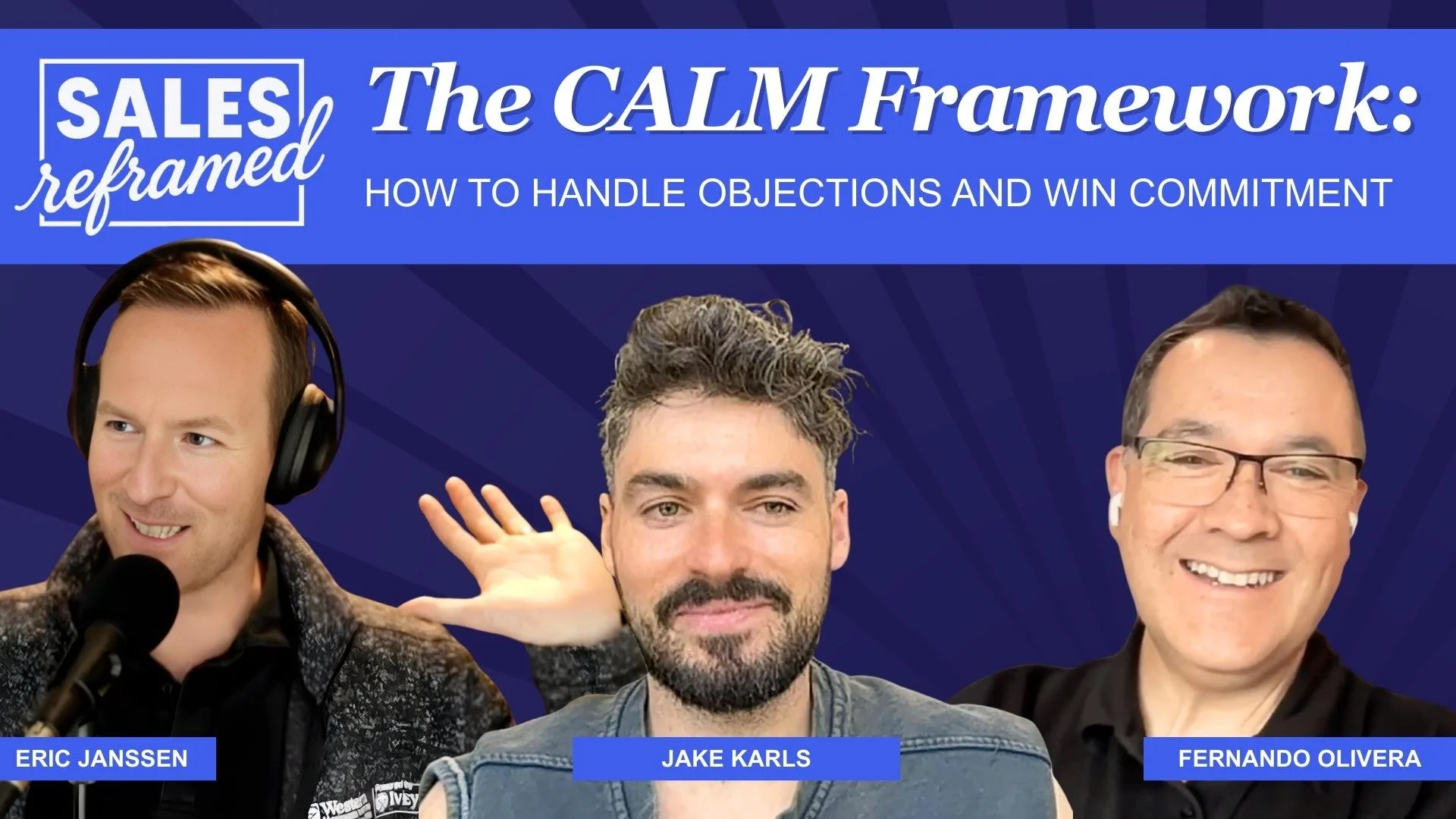
This episode introduces the CALM framework (Catch, Acknowledge, Loop, and Move forward), a simple, practical way to handle objections without losing trust, momentum, or the deal. With real-world insight from Mid-Day Squares co-founder Jake Karls and Ivey Business School Associate Professor, Fernando Olivera, the episode reframes closing and commitment not as a battle to win, but as a collaborative process to earn commitment that lasts.
Reframe Takeaway
After listening, you’ll understand that objections aren’t rejection. They’re information. When sellers stay calm, get curious, and respond collaboratively instead of defensively, objections become a pathway to clarity and commitment. Using the CALM framework helps you slow the moment down, understand, and move forward in a way that earns trust and leads to mutually beneficial agreements people actually want to follow through on.
Episode Guests
Jake Karls: Co-Founder and Chief Rainmaker at Mid-Day Squares.
Fernando Olivera: Associate Professor of Organizational Behaviour at the Ivey Business School; Faculty Director of Ivey’s EMBA and AMBA programs.
Top Episode Learnings
Objections Often Signal Engagement
When someone pushes back, it’s often a sign they’re engaged and thinking seriously about the decision. The real danger isn’t objection. It’s apathy. Learning to recognize this distinction helps sellers stay composed and see objections as valuable insight rather than rejection.The CALM Framework Creates Clarity Under Pressure
High-stakes conversations often trigger instinctive responses. The CALM framework provides a simple structure for slowing the moment down, making sense of objections, and responding in a way that preserves trust and moves the conversation forward productively.Commitment Comes from Collaboration
Closing isn’t about winning an argument or finding the ‘right’ words. It’s about building an agreement that each side wants to follow through on. When objections are handled collaboratively, they lead to clearer expectations, stronger relationships, and commitments that actually stick.
Resources Mentioned in This Episode
Case Example: Mid-Day Squares’ multi-year effort to secure retail distribution with Costco Canada.
Handling of Prospective Customers’ Objections by Salespeople: A Double-Edged Sword? Article by Bruno Luissier, Haythem Guizani, and Jean Ouellet, Conference: National Conference in Sales Management (2015).
Foundations of Collaborative Negotiation and Commitment Formation
Insights drawn from Fernando Olivera’s research and teaching in organizational behaviour, negotiation strategy, and leadership at the Ivey Business School.
Transcript
[STIRRING MUSIC]
ERIC JANSSEN: A few summers ago, I was at our cottage and suddenly started feeling incredibly tired, just completely drained. I figured it was the heat or maybe I had been overdoing it with some yard cleanup. But then came the chills and body aches. This was beyond a normal sickness. Something definitely wasn't right. But I couldn't figure it out. Then my wife spotted it, the signature bullseye mark on my leg from a tick bite. Given the symptoms, I got to the doctor's office, underwent some tests, and they determined pretty quickly I had Lyme disease.
If you're not familiar with Lyme, it's an infection caused by bacteria found in certain species of ticks. It often starts with flu-like symptoms or a signature bullseye rash. But if it progresses, it can spread through your body and affect your heart, even your brain and nervous system. This can get serious pretty quickly, which means there's a real need for early detection. That's exactly what one of my students was pitching a few years ago to a room of her peers, an at-home test kit that would allow you to determine if you were at risk for Lyme disease. It was an idea she'd been tinkering around with over the summer. And she brought it to a pitch day that I'd set up at the beginning of the semester.
Imagine a room with 500 students, as well as a panel of judges, who listen to the pitches and give feedback. So she gave her pitch. And one of the judges on the panel was just digging into her, how long have you been working on this? What's the science to support it? How far along are you in the development? And the more he pressed, the more you could see her getting frustrated and honestly, a bit angry, until she'd finally had enough. I don't know. I'm still trying to figure it all out. After a few seconds of awkward silence, the judge took a beat and explained exactly why he was pushing her so hard.
The reason I'm asking is my wife had Lyme disease and it really impacted her. If you have something real here that could actually help those impacted, I want to invest in it today. The investor wanted in, but my student shut him out. She read the pushback as disinterest when it was actually the opposite, engagement, curiosity, and potential investment. And honestly, it's one of the biggest reasons deals fall apart in the last minute. So this week, we're talking closing and commitment and how to recognize the opportunity hiding inside an objection.
[UPBEAT MUSIC]
I'm Eric Janssen, an entrepreneur turned sales professor. And I have a simple mission, to change the way that people think about sales, because sales is a life skill. And this is Sales Reframed, a podcast brought to you in partnership with Ivey Executive Education. This week we're closing deals left, right, and center. And to help us, we're calling in Jake Karls, Co-Founder and Chief Rainmaker at Mid-Day Squares, and my colleague at Ivey, Negotiations Professor Fernando Olivera.
So back to my student, what exactly did she do wrong? On the surface, you could say she lost her cool in a stressful situation. And maybe that's true. But I think the more important question to ask here is what didn't she do? Objections come up all the time, especially at the last minute. And a lot of times, we make the mistake of thinking that someone who asks hard questions is an antagonist. They're trying to push us off or let us know that they're not interested.
But I don't think that's always the case. If the investor hadn't been interested in the Lyme kit, he probably would have just tuned out of the pitch altogether, maybe started checking his phone. And that's apathy. And that's truly a bad sign. If someone's checking their emails instead of paying attention to your pitch, you're probably cooked.
But this guy was engaged. He was interested. He wasn't trying to make her look bad at all. It's so easy to get caught up in the heat of the moment and get defensive or reactive when what we really want to do is be attentive and reflective.
So what should my student have done instead? In these kinds of high pressure situations, I think it's really important to reframe the objection. And to do that, I like to use something called the CALM framework. That's C-A-L-M, CALM. It stands for Catch, Acknowledge, Loop, and Move forward. I'm going to be talking about CALM a lot in this episode. So to help unpack what it means and show us how it works in practice, I'd like to bring in our first guest.
JAKE KARLS: Now, Costco Canada has been a phenomenal retail partner of ours. We pitched them for three years and we actually didn't get in for three years.
ERIC JANSSEN: That's Jake Karls. He's the self-described Chief Rainmaker of Mid-Day Squares, a better-for-you refrigerated snack bar that he co-founded in 2018 with his sister and brother-in-law.
[UPBEAT MUSIC]
Jake's a graduate of Western. And in 2023, he was named one of Forbes 30 under 30 for Mid-Day Squares' rapid growth and standout branding. And yes, you heard him right, it took Mid-Day Squares three years to close a deal with Costco, where you can now find their products on the shelves. And Jake used that CALM framework to make it happen, even if he didn't know he was doing it at the time.
JAKE KARLS: Basically, at the beginning, we just went in with our product. We thought they'll take it. And we had our price point. And they just didn't. They disagreed. We worked through it and we couldn't get to the destination we want to. So then we asked them, what else can we do? Again, the question. They basically said you could do a road show, which is basically a sampling in warehouses at Costco, where you sample and then you sell your product at the price point you believe. What we did was we asked them, what is the record? What is the number 1 amount of product sold in a road show in history in Canada? And they gave us the number.
And what we did is we told our team, we said, guys, all that matters is that we blow past this record. So we need to do whatever we can in our power to show Costco that we deserve to be in their refrigerators. And what we did was we worked with our skills of social media, influencers, local media, and our community that we've been building for years to come support us. We asked them to come support us. And we blew past the record. And in the end, what that did was it told our buying team at Costco, wow, our members like this brand and want this brand. And that aided the process, from when the negotiations happened to after, where it was like, OK, now we're playing at a different level because the risk isn't there anymore, and their members, who are the most important people to them, want this product.
ERIC JANSSEN: Jake's experience with Costco is a great example of handling an objection and reframing it as something to solve collaboratively. When Costco said no, Jake and his team didn't take the Kool-Aid man approach and try to just smash through the wall between no and yes, if anyone listening is old enough to get that reference. They didn't get defensive, or try to talk around the objection, or tell Costco, no, actually, we're right and you're wrong. He did the opposite. He caught it. That's the sea in CALM, Catch.
Well, I've done the pitch. We have a follow-up meeting and they say, hey, Jake, we appreciate the brand. It's a no right now. What are you doing immediately after the hammer drops? In there, is that where you're asking, like, help me understand what is it so that you can eventually come back to them? Or is it like in that meeting right now, we must objection handle?
JAKE KARLS: We asked what we could do better. What do you guys need from us? And sometimes they'll say-- in Costco's case they didn't say this, but in other retailers they've said, it's just not the right time. And that's all. Some other retailers will tell us, OK, maybe your packaging needs to be a little bit different or we need to get the price down to a different price point. And then we'll go back to our team and see if that's possible, because you can't just lower the prices to the point where you disrupt other retail partners or things like that.
We don't just object right away. We focus on making sure during that meeting, no matter what, we are still trying to build a relationship. Because it might be a no today. That doesn't mean a no tomorrow. And I think that that's the most important thing. You never want to jeopardize and burn a bridge. I know people get emotional. Their ego gets in the way. Prevent that. That is the worst possible thing you could do. Even if you deserve to be in the store, even if you are the best, your ego and your anger needs to be held back.
Remember, a no today does not mean a no tomorrow. And once you understand that, you come back to your drawing table and then you go back, when you're ready, with something new, with a new angle. And they might not answer you, but that's OK. You'll go back again in a year later. I think that as long as you're not harassing or doing anything like that, you're in a good flow. And I think that all you're trying to do is have a WW, a Win-Win for everybody. And if you could continue to offer that, eventually, I believe, your domino will fall. I eventually believe.
Whether it's a new buyer that comes on the desk or whether they're looking for your exact trend of what you do, they need that item, at least they like you as a person and they respect you. And I think that's the most important thing, because we've been called in to a retailer because they said no to us and then years later, two years later, they said, we're actually investing in this set. We need more products. Are you guys ready? Boom! in.
ERIC JANSSEN: You're playing the long game?
JAKE KARLS: You can't play the short game, Eric. I think the overnight success stories are bull [BLEEP]. No offense. I think there is one and many that will have a three-year billion dollar outcome, whatever it is. But most of the things are 30-year overnight success stories, 20-year overnight success stories. And you look at athletes, they train their whole life to play in the NHL, NFL, UFC, whatever the sport is, 10 years or whatever it is. But they were training 15 years prior. So it was a 25-year storyline.
ERIC JANSSEN: When an objection comes, don't try to swat it away or sidestep it. Catch it with soft hands. Realize it's an invitation to have a conversation, not a rejection outright. Then he, A, Acknowledged it. You should pause, absorb the objection, and then normalize it. Don't get defensive. Don't just start talking. Instead, let the customer know that this is a reasonable thing to bring up. It can be as simple as saying, that's a great question. For Jake, he didn't see the objection from Costco as a signal to pack up and leave, but as an opportunity to creatively problem solve. And that's the L in CALM, Loop back to understand it. That means clarify by asking thoughtful follow-up questions, summarize what you heard, and make sure you really understand what the objection is and what's behind it.
For Jake, it meant asking Costco really smart questions. What are you actually worried about and why? And digging deeper made him realize that the objection wasn't about price at all. It was about customers' willingness to accept a new category and ultimately pay for a product they had never heard of before. Costco was worried this product would take up shelf space that could be better allocated to a more established brand.
JAKE KARLS: That's the part we talked about before, is for Costco is like, OK, can we blow up with noise? Can we make as much noise as possible to make it so noisy that you need to carry the product. And that's what we did. So we went back to the table and we asked-- and we just didn't stop because what we believe is a no doesn't mean it's over. A no is how do you now come back at a different angle. How do you come back at a new conversation. How do we de-risk it more. How can you get creative.
And I think that that applies to everything, whether it's a big retailer or small retailer, an investor, or a media a journalist that you want to speak to. It's how do you come at it differently that will now connect to them. Because it's all about connectivity. It's all about hitting something that matters to that individual or that group. We just kept coming until it worked.
We understood that the road show, in this case, was a way to get us one foot in the door by showing our actual superpower, which is storytelling, which is making noise, which is making our community excited. And we wanted Costco to see that and feel that.
ERIC JANSSEN: And understanding that gave Mid-Day Squares a pathway to M, Move forward. That's the step where you give your best possible response to whatever the real objection is and work collaboratively with the customer to get past it. Once Jake understood the real objection, he realized he needed to de-risk this investment for Costco and prove demand.
So he proposed a solution that would demonstrate that they could get the customer on board. Not just that customers would purchase the product, but they'd be excited about it. And they knew that excitement would carry over from the customers to the real decision-makers at Costco.
JAKE KARLS: Because if they felt it, then we didn't have to sell it to them. It was them experiencing it. Their ground staff were experiencing it. Their managers, their category managers, they were seeing the numbers. We didn't have to tell them, hey, look how many Mid-Day Squares we sold. No, it's in their system. And that way we would de-risk it even more for our category manager and make them feel like it's not such a risk.
Because, look, we're not Pepsi, Eric. We're not Coca-Cola. We're not Kellogg's or General Mills, who have been around for 50-plus years and have proven track records of tons of data, of moving immense amounts of products. We don't have that. We have five years of retail data. We're still a new brand. We're still new in certain countries. And yeah, our data is good, but we don't have millions of dollars to spend on investment into the marketing, into the budgeting, into the promo planning.
So we have to be different. You have to be able to be different. You have to be able to show that you're going to win no matter what in their stores or in their organization. And if you can't do that, you're not going to get in. If you're a disruptor, you're a new innovation or you're a smaller brand, it is 10x harder to get in because you need to prove that you're going to beat the incumbents. And the incumbents already have the placement. They have data.
They've been there. They've built a relationship. You need to outdo all of that. And the only way to do it is to be different, is to use your superpowers, is to use data, and is to make sure that you get these people to like who you are as a person, because once they like you, they're going to do a lot more, whether they subconsciously do it or consciously do it. And that's worked countless amounts of times for us.
ERIC JANSSEN: Jake's now conditioned himself to view objections as opportunities. He and his team didn't leave that initial meeting with a yes, but they left with the next step. Give us a shot in some key stores and we'll do the work to get Costco employees and customers excited about Mid-Day Squares. Let us prove it to you store by store. So they got to work doing what they do best, getting people fired up about the product and making it impossible for Costco to ignore the buzz of excitement around Mid-Day Squares. It's an approach that's central to a lot of the deals that Jake and his team have been able to close. So I wanted to pick his brain more on how he deals with hard questions and pushback from potential customers.
I think when students take a sales class or want to learn about sales, they for sure expect a session on closing, right? How do we close the deal? What do I say? What are the magic words?
JAKE KARLS: Number 1, persistence. The ability to withstand pressure and keep getting up is critical. The second part, I think, is one of the best things for sales in the world for closing is show up. And what I mean by that is whenever you have a chance to show up in-person, get on the plane, get on the bus, get on the train and go meet the person if it's for 5 minutes, an hour. It shows respect. It shows that you're willing to get things done. And that's what we did with Costco. Wherever we had the chance, we would show up. It's what we've done with every retailer partner that obviously allows us to show up.
And what it does psychologically, in my opinion, is it tells the other person that you care and that you're willing to do things that maybe others aren't willing to do. I can't tell you how many times, Eric, that showing up, getting on the plane for a 5-minute meeting has closed the deal for us. And whether it be an investment, whether it be a retail partner, whether it be a new team member we're trying to close, that has been the most consistent return on investment for closing possible, given that we did everything else.
I've seen the difference of brands that don't show up. And they'll do it just like they'll take Google Meets or the Zoom call. You don't have the ability to see the serendipity potential of the unknown that can happen within energy passing. I'll never forget, I was with an investor and we sat down at a coffee shop. I was trying to close this deal. I showed up and we were having a great talk.
And then somebody, a fan, came up that was a huge fan of Mid-Day Squares and said, oh, my god, I don't mean to disrupt this meeting, but I'm a huge fan. I eat your product all the time. Can we take a picture? Boom! Closed the deal, my friend. Why? Because that person on the other side of the table, because of that serendipitous moment, said, holy [BLEEP], how can I not invest in a brand that gets spotted in a city that's unknown and closes the deal? Show up, allow for serendipity to happen. And don't give up. Because if you give up, that's the failure, is the give up.
ERIC JANSSEN: Deals rarely live or die in one moment or in one single meeting. It might feel like you have your back up against a wall or like you have to close this deal right here and right now. But honestly, that's rarely the case. Instead of panicking to close the deal, take the time to really understand what the objection is actually about and then work toward a win-win solution. That's how Jake and his partners have built Mid-Day Squares into what it is today, a multi-million dollar brand competing with the biggest in the world.
And I think part of the beauty of the CALM framework is that it's a way of stopping the clock for a second, takes you out of that reactive mindset, and forces you into one that's being more reflective. Instead of just trying to convince the other person that their objection is flat out wrong, it gives you the time, the space, and the methodology to actually understand the objection. And that's huge. And that's a great segue into my next guest, Fernando Olivera.
FERNANDO OLIVERA: One of the reasons people are uncomfortable about negotiating is because they know that, inevitably, the other side is going to say no to their initial proposal. If they said yes to the initial proposal, there will be no negotiation. So you need to be prepared for that. For the idea that we're not going to get it right the first time.
ERIC JANSSEN: Professor Olivera is an Associate Professor of Organizational Behavior at the Ivey Business School and faculty director of Ivey's Executive MBA and Accelerated MBA Programs. He's also a friend and colleague and a highly respected expert in negotiations, leadership, and communication strategy. And that idea of shifting from reacting to reflecting, he's all about it.
FERNANDO OLIVERA: There's a chance we're going to have to engage in a back and forth to build something that is worth constructing. That's what can be motivating, constructing something that is better when you have thought about initially. If you can get past that feeling of rejection because the other side says no to what you offered the first time, then you may come to recognize that it opens the opportunity of doing something that truly addresses the other side's concerns. And if that's what you accomplish, then the benefit may be in the long term, because people would rather engage in business with those who understand their concerns and know how to address them.
ERIC JANSSEN: Fernando spends a lot of his time teaching executives how negotiations work, what elements need to be in place for them to be successful, and common reasons they fall apart. Negotiations and sales are definitely related, intertwined even, but they're not exactly the same. For me, an easy way to think about the difference between them is that sales is about mutual understanding and determining fit and negotiations are about coming to an agreement on terms. Here's how Fernando sees the relationship between the two.
FERNANDO OLIVERA: My sense is that negotiations typically involve some element of selling. When you're negotiating, you are making a proposal to the other side about the things that you can offer to them, the reasons why what you're asking for is justified, the benefits to engaging with you, and all of those things, in my mind, are sales activities. I'm persuading, I'm selling to the other side what it is that I can offer to them and what I can bring to our relationship.
I think that sales sometimes include negotiation. Some sellers are so persuasive that they convince the other side to what it is that they're selling. The negotiation component comes when the other side says, well, that's not entirely what I'm thinking about. That's not entirely what I want. And then we go back and forth to figure out whether there's ways for us to make concessions that allow us to construct an agreement that is acceptable to both sides.
ERIC JANSSEN: Fernando has spent decades helping professionals become more effective negotiators. One of the key lessons that he teaches is not to get too deeply entrenched in your own position or your need to win. Instead, put that effort toward working collaboratively and trying to understand what the other side actually needs or wants, even when they aren't sure of it themselves. It's the same rationale behind the CALM framework, looking at objections not as a hurdle, but as a way to better understand your customer. For Fernando, it's about seeing a negotiation as the beginning of a commitment, rather than a way to get to an ending as quickly as possible.
FERNANDO OLIVERA: If you're engaging another party with the intention of coming to an agreement that you can implement, that is in both of our best interests to follow through, then commitment comes from gaining an understanding about those benefits to you and I from following through with our agreement.
So I would say that if you are crafting an agreement with your client that makes explicit the benefits to them and how their needs are being addressed through the solution that you have put together for them, then commitment follows from their recognition that following through with the agreement that you are putting together with them is better than not doing it.
I suspect that if you have situations when-- and you've heard the term, and I'm sure that you talk about this in other contexts, of overselling, which is making promises that you can't really keep or selling benefits of your services or product that the client is ultimately not going to realize, they may figure that out early enough in the process that they'll decide, no, this is just not sitting right with me. I don't believe that the other side can deliver on the promises they're making. So if they don't think you can deliver on your promises, then why would they commit to continuing in an engagement with you?
ERIC JANSSEN: Fernando believes that all successful negotiations, and by extension, sales, come from a place of collaboration. I mean, think about it, the worst version of sales is the kind where you're trying to convince someone to do something that they might be hesitant about doing. Pressure tactics, magic words, all that stuff. It might work every once in a while in the short term, but it's the opposite of how high-stakes complex selling actually works.
Let's contrast maybe, like, a combative type of negotiation with a collaborative type of negotiation. How would they differ practically?
FERNANDO OLIVERA: Yeah, I that there's some interesting tales. One of them has to do with the initial requests. And when you see someone who makes an outrageous initial request, you know the following, the playbook of competition, of trying to get as much value out of you as possible. And they do that in part because they know that extreme requests lower the confidence of the other side, change their expectations, and may even make them go beyond what they know it's in their best interest.
When someone goes beyond what's in their best interest, there's a good chance they're going to fail in implementation because they will have the incentives to claw back some of the value that they gave up along the way. So that would be an indication that you're in an environment that is not collaborative.
The collaborative one starts by saying, what is realistic? What can I offer you that you would likely follow through with? That if you make a commitment to me with this particular terms and conditions, you have an incentive to follow through and you have an incentive to do it because it's better to follow through with your promises than not to do it? So the collaborative mindset starts with more realistic expectations.
I think that the combative and competitive one tries to trick the other side into agreeing to things that are not in their best interest by throwing a lot of information, changing the conditions under which you negotiate to have more pressure, perhaps by creating artificial delays to put the other side in a position where they feel that they have to make last-minute concessions. All of these things with the hope that they'll make mistakes on their end and that those mistakes are going to be to the advantage of the person who is taking those combative moves.
If people make mistakes in negotiation, it shows up in implementation, because now it turns out that I can't deliver the parts that you required of me because I don't have the technology or the support internally to do it. A more collaborative approach would be what can you promise that is realistic and how can I help you deliver on your promises. Can we make sure that on your side, people are aligned within your organization so that they support this agreement, that they see the great benefit in us working together. So I think that it shows in how parties relate to each other during the conversation about what they can explore.
ERIC JANSSEN: If we take Fernando's advice to heart, that we should be collaborative, not combative, then that's going to influence how we handle objections. The collaborative approach takes more time. And spending more time on individual sales is counter to what we're often taught, because spending too much time on making any one single customer happy means our overall performance would suffer, right? Well, that's the hypothesis that a group of researchers, led by a friend and colleague, Bruno Lussier, put to the test in a 2015 paper titled, "Handling of Prospective Customers Objections by Salespeople, a Double-Edged Sword?"
But what they found was that when salespeople were customer-oriented and had expert knowledge of what they were selling, then good use of objection-handling skills improved both sales performance and seller customer relations. And that's how you achieve a win-win.
[UPBEAT MUSIC]
If we look at this in terms of the CALM framework, think about the idea looping back to understand what the customer really needs. When Fernando talks about collaborative negotiations, I believe this is exactly what he's talking about. It can be difficult in the moment and it often takes more time, but in the end, it can lead to better outcomes.
Any advice on how to do that better? How do you make sure that you cleanly elicit the real needs, pains, issues from the other side?
FERNANDO OLIVERA: Good question. And I suspect that there's maybe two different reasons why we may not understand the other side well. One, maybe because we don't ask the right questions or we don't listen to the answers carefully. Sometimes when we're in selling mode, we ask a question but we're not really hearing the answer. We're trying to figure out how we can sell based on the words that are said in that answer. So we're not necessarily truly understanding what the other side cares about. That's on us. If we don't do a good job listening and asking good questions, then we're going to have a limited understanding of what they want.
Another possibility is that the other side doesn't know what they want. And it is possible that they're engaging you because they're trying to gain clarity on the service that they actually need. And the process through which they have engaged you may give them some clarity. And maybe that clarity is one that this is not what they need or maybe it's not sufficient for them to be able to commit to a particular path. So that's more on them.
We can have an effect on that by presenting information clearly, by asking follow-up questions, by probing if there's more information they need from us. Certainly concealing information or trying to trick them is not going to help us. We really want to be transparent in what we can offer to them and sometimes even educate the customer on the things that they may need.
Imagine a scenario where after we understand the requirements, we conclude that we're not the right partners for them. Do we tell them, I'm not who you need? You need someone else because the requirements that you have, I'm not the right person for doing that, to help you accomplish those goals.
It goes back to our preparation, as we talked about earlier. If I had clarity on my goals, on their goals, and how I can help them, I may be already making some progress in that direction. But it is conceivable that I'm going to discover through the process that their goals are not where I thought they were and maybe they gained understanding of their goals through interactions with us.
And think about how much do we appreciate the sincerity coming from us in saying, you're better off doing work with another partner or I hear some recommendations that I have for you. There's a good chance that when they do need what we have to offer, they're going to call us.
ERIC JANSSEN: I love Fernando's approach because it recognizes the importance of the long view. It's better to leave the customer happy, even if it means losing this particular sale. Why? Because misrepresenting yourself as the solution to their issue when you're actually not will result in bad outcomes for both sides. That's M in the CALM framework, moving forward. Sometimes that means walking away because the fit isn't actually there and that's still a win-win.
I believe you should think about closing as a kind of commitment, a commitment to fulfilling whatever promises you made to hold up your end of the deal. And a commitment has two parts, it's both intent and action. It's saying and doing the thing. And to be truly successful in the long term at sales, it means following through on both parts, honoring your commitment. It's the commitment to keeping your word, to being an honest person. That's what sets you apart in the world of sales. That's how you build your reputation and get word-of-mouth referrals and set yourself up in the future.
[UPBEAT MUSIC]
And that brings us to the one thing for this episode. Remember, when you encounter an objection, don't look for the fastest way to talk your way over, under, around, or through it. Instead, catch it softly, acknowledge it, loop to understand it, and then collaboratively move things forward. It's so important to recognize that these interactions shouldn't be combative and that objections are not rejections. When people ask hard questions or push back against you, look at it as insight into what your customer actually cares about as an invitation to collaboratively solve a problem.
Sometimes in sales, we trick ourselves into thinking that any customer is a good customer. It's a volume game. So the more customers, the merrier, right? In truth, most companies don't starve from a lack of opportunity. They drown from a lack of focus. And the best way to focus, truly, deeply understanding your customer and using that knowledge to pick your best opportunities for success.
Our guests next time around are masters at understanding their customers. We're lucky to have Michael Tamblyn, the CEO of Rakuten Kobo, Lauren Lake and Mallorie Brodie of Bridgit, and co-founder of the international sports sensation, The Savannah Bananas, Emily Cole. The Bananas are turning the world of baseball on its head by putting the customers ahead of everyone else. In fact, fans are so central to the Bananas that they even named their company after them.
EMILY COLE: We just started very clearly with our mission. With the company's name being Fans First, our mission is fans first, entertain always. So we are either putting the fan first and taking care of them in some capacity or we are entertaining them.
ERIC JANSSEN: This has been an episode of Sales Reframed, and I'm your host, Eric Janssen. Huge thanks to my guests this week Jake Karls and Fernando Olivera. We have links in our show notes to learn more about these folks. And if you haven't tried Mid-Day Squares yet, you have to.
This podcast is brought to you in partnership with Ivey Executive Education, part of the Ivey Business School, consistently ranked among the top business schools globally. Ivey Executive Education delivers high-impact learning experiences for organizations and leaders at all levels.
From custom design programs to coaching and open enrollment courses, Ivey works with executives and business operators around the world to drive real results. Their mission, like ours, is to turn cutting-edge research into practical insights that help people learn, grow, and succeed in a changing world.
This show takes a village. I'd like to thank our executive producer, Sean Acklin Grant, and our editorial advisor, James Greenhill. Our audio engineer and producer is Carol Eugene Park. And our narrative producer is Michael Catano. Thanks also to our creative directors Cristina Ball and Michelle Stanescu. Thanks for listening. We'll see you next time.
[UPBEAT MUSIC]
About Sales Reframed
Sales Reframed is a podcast that redefines sales as the ultimate life skill. Blending research, storytelling, and strategy, it explores how influence, resilience, and purpose drive success in every field.
Developed by award-winning professor and entrepreneur Eric Janssen, and in partnership with Ivey Executive Education, the show makes sales human, practical, and accessible to everyone.