
The Future of Sales: How to Stay Irreplaceable in the Age of AI
Every technological shift creates two reactions:
Fear of displacement.
Or opportunity for differentiation.
AI is no different.
Yes, some sales tasks are shrinking. Yes, entry-level roles are evolving. Yes, automation is accelerating.
And unfortunately, none of us has a crystal ball. We can’t predict what sales will look like in six months, let alone six years from now.
But here’s what we can do:
Less speculation.
More preparation.
More future-proofing.
Because future-proofing isn’t about fighting AI. It’s about understanding where technology ends and where human expertise begins. It’s about positioning yourself where value is heading.
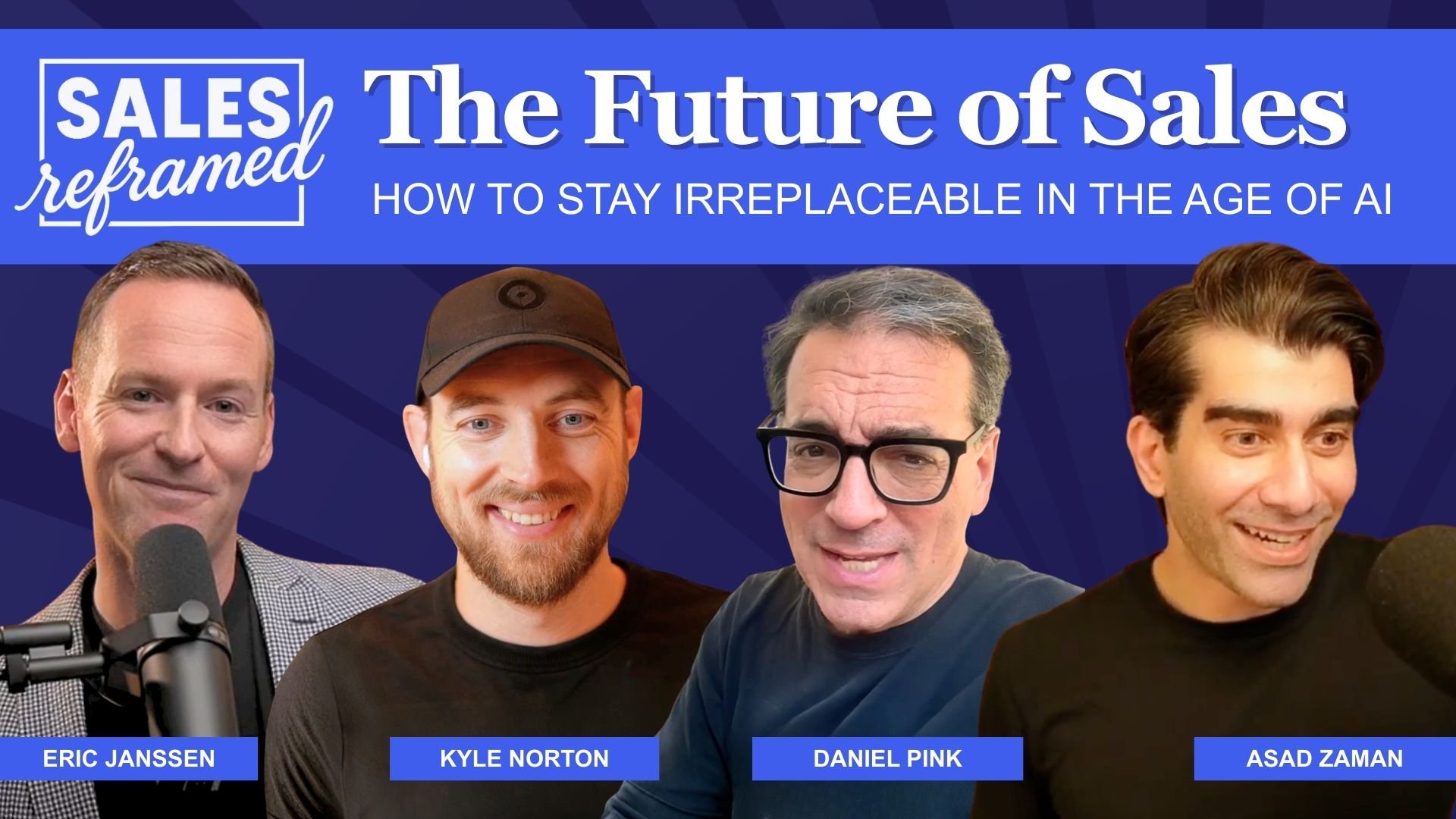
In this episode, Kyle Norton, CRO of Owner.com, shares what becoming a radically AI-native actually looks like inside a fast-growing revenue team and how automation can eliminate low-value work so humans can focus where judgment matters most.
Then you’ll hear from Asad Zaman, CEO of Sales Talent Agency, tackles the career question many are quietly asking: if traditional Sales Development Representative (SDR) and Business Development Representative (BDR) roles compress, how does the next generation of sales professionals build experience and climb the ladder?
And finally, bestselling author Daniel Pink reminds us that while AI may change the tools, the core of persuasion still rests on human judgment, resilience, and the ability to truly understand another person.
AI can do the homework. But as the stakes rise and decisions matter more, the hard work stays human — judgment, trust, and the ability to understand what someone truly needs.
That’s where value moves. That’s where you compete. That’s where you stay irreplaceable.
Reframe Takeaway
After listening, you’ll see that the real question isn’t “Will AI take my job?” — it’s “Where do humans become non-negotiable?” AI will keep absorbing the homework: research, admin, drafting, and high-volume execution. That part will only accelerate. But the people who stay essential will be the ones who lean into what technology can’t replace: reading the room, handling resistance, asking the better question, and finding the real problem before there’s a script for it. Future-proofing isn’t about fighting AI. It’s about partnering with it and positioning yourself where judgment, trust, and human connection are the value.
Episode Guests
Kyle Norton: Chief Revenue Officer at Owner.com.
Asad Zaman: CEO of Sales Talent Agency.
Daniel Pink: International bestselling author of To Sell is Human, Drive, The Power of Regret and others.
Top Episode Learnings
AI Handles the Homework. Humans Do the Hard Work.
The research, note-taking, data enrichment, and workflow automation are increasingly AI-enabled. That raises the baseline in sales by accelerating the traditional ‘homework’. What remains is the hard work: structuring the conversation, adapting in real time, and deciding how to move a deal forward when the path isn’t obvious. As preparation becomes automated, differentiation shifts toward execution. Technology accelerates sales readiness, but outcomes still depend on how well you apply it.AI-Native Is a Strategy, Not a Tool
The question isn’t “Where do I start with AI?” it’s “How do we build an AI-native organization?” The companies that win won’t be the ones experimenting with isolated tools – they’ll be the ones building strong data foundations, internal capability, and leadership fluency. AI isn’t a box to check. It’s a transformation and skillset to own.Career Pathways Will Evolve – Expertise Is The Real Advantage
Entry-level roles in sales may compress. Prospecting may become AI-assisted. But the bigger shift isn’t elimination. It’s acceleration. AI enhances the performance of skilled professionals far more than it elevates the unprepared. As technology becomes a co-pilot, expertise becomes the multiplier. The ability to prompt well, interpret insight, and apply experience determines whether AI becomes an advantage or just noise. The career ladder may evolve, with better sales simulations and more structured development, but advancement will still depend on building real human expertise and capability, not just tool fluency.The Human Edge Becomes the Differentiator
As automation accelerates, baseline competence rises. What separates professionals isn’t access to information — it’s how they show up in consequential moments. In higher-stakes decisions, when ambiguity increases and risk is real, buyers still look for judgment, credibility, and reassurance. The ability to navigate complexity, handle resistance, and earn trust becomes more valuable, not less. Technology may assist the process. But in pivotal moments, humans remain in the loop.
Resources Mentioned in This Episode
Case Example: AI enhanced technology tools used in producing the Sales Reframed podcast include Riverside, Otter.ai, Gemini, ChatGPT, Claude and others.
Case Example: Kyle Norton, CRO at Owner.com, cited AI tools including Momentum in his interview for Sales Reframed.
Reference: Owner.com raised $120M in a Series C funding round, valuing the company at $1B.
Reference: The Federal Communications Commission ruled that AI-generated voice robocalls are illegal without prior consent from the recipient.
Reference: Marc Andreessen, “Marc Andreessen predicts one of the few jobs that may survive the rise of AI automation.” Fortune, May 1, 2025.
Reference: “AI Is Shifting the Workplace Skillset, But Human Skills Still Count,” by Karin Kimbrough, Chief Economist at LinkedIn. Published by the World Economic Forum.
Book: “To Sell Is Human: The Surprising Truth About Moving Others” by Daniel H. Pink
Reference: “How AI Chat Is Rewriting B2B Software Buying: Insights From 1,000+ Decision Makers,” by Tim Sanders, published by G2 (Oct. 6, 2025).
Note: The MIT research paper discussed in this episode of the podcast has been requested for withdrawal following an internal MIT review. MIT posted a notice on its website explaining the decision (linked here).
Transcript
[MUSIC PLAYING]
ERIC JANSSEN: When I talk to colleagues and students, there's a concern that AI is coming for our jobs. The fear is that sales as a profession is at risk. And look, I don't have a crystal ball. Nobody can predict what the world's going to look like six months from now, let alone six years from now.
But here's what I do know. Change is happening fast. And as an educator, my job isn't so much to predict the future, it's to help my students prepare for it. This episode is called The Future of Sales. But it's not really about the future. It's about future-proofing yourself. It's about understanding where technology ends and human experience begins, and how you position yourself to stay not just relevant but essential.
I'm Eric Janssen, an entrepreneur turned sales professor. And I have a simple mission, to change the way people think about sales because sales is a life skill. And this is Sales Reframed-- a podcast brought to you in partnership with Ivey Executive Education.
If you want to see how AI is changing the way people work right now in real practical terms, you don't have to look much further than how this podcast is made. It's a very small team of people, all talented professionals, with complementary expertise across a variety of fields.
There's actually a lot that goes into making a show like this-- research, project management, personnel management, publicity, scheduling, budgeting, writing, editing, mix engineering, sound design, and so on. And we use AI tools in a bunch of meaningful ways.
One tool has made it really easy to get high-quality transcripts of the interviews. Another gives us really handy summaries of our team meetings. And there's some AI on the back end of an audio repair tool that we use to clean up sometimes my bad recordings and background noise.
I've even used an AI tool to help work out how an episode or two could be structured and how to tie the guest interviews together. It's a way to bounce ideas around when I don't have access to the rest of the team.
And I think this is a great example of how new technologies tend to insert themselves into our work lives. They haven't really changed the show at the core. It's still human-to-human conversations. But it has made the way that we put it together a little bit more efficient. But what's at the center of all of it is a group of humans doing human work that we care deeply about.
Now, to be sure, there's a trade-off. The money that goes to AI-generated transcripts used to go to transcription services that employed real humans. And over the past few years, that job has become near extinct. And when we look at sales, we're starting to see similar trade-offs happening there, too, particularly when you're looking at high-volume, low-margin types of products.
If you're Temu, flooding Facebook with ads for cheap goods, you don't need humans signing off on every iteration of an ad. You need algorithms talking to algorithms. So things are changing, and they're changing fast. But there's still a place for human expertise, creativity, and judgment in the middle of it all, now more so than ever. And that's where our first guest comes in.
There are definitely companies out there that are not only learning how to roll with these new technologies but deeply embedding them into the way that they do business, especially when it comes to their sales teams. And one of those companies is Owner.com.
KYLE NORTON: And we should be operating under the assumption that people are using AI constantly. The way the world is moving, I can tell you this, as an operator on the ground, is I am pushing everybody on my team to use AI all of the time.
If universities aren't steering all the way into AI and not just allowing it but encouraging their students to be using AI constantly, then I think we're setting people up for the wrong things going into a career because your employer doesn't care.
Your employer doesn't care if ChatGPT or Claude cowrote that email. They just want a great work product. And I'm hoping that education leaders hear that message and lean into it because I can tell you day 1 that somebody starts with me, I'm not criticizing their use of AI, I'm wondering why they're not using AI more, if anything.
ERIC JANSSEN: Kyle Norton is the Chief Revenue Officer at Owner.com-- a fast growing SaaS platform for local restaurants. They're approaching $100 million in annual recurring revenue and just raised $120 million series C at $1 billion valuation.
And they're doing it while being radically AI native. Owner uses AI tools for everything from scraping contact data while looking for new leads, to figuring out which leads might have the best chance of leading to a sale. They use it for collecting customer data during calls and feeding that data back into their CRM, product teams, and even into their marketing.
They even use it for training new hires, both to help develop training materials, as well as run training simulations before sending reps out into the wild. Suffice it to say, owner is very much an AI native company. And they're using the tech in really detailed ways. But where should most sales teams start?
KYLE NORTON: When I think about-- the question I get most frequently is, where should I start with AI? And how I'm trying to reframe that to people is the question isn't like, where do I start? The question is, how do I transform my company to be AI native? Because, Where do I start? implies there is a starting point and an ending point, and it's this linear thing.
But I think this transformation that we're going through is much more organic and recursive. There are going to be these feedback loops and changes, and so you want to build antifragility into your organization.
It's not, how do I go through this series of steps to use this thing? It is, how do I need to transform my business so that we now take advantage of this rapidly changing technology landscape?
And so one is data foundations, like nothing else will really work until you have good first-party and third-party data. I generically tell people to start there. Start with your data because AI is built on data. It is just a data model.
The other piece of this journey is like, what is your transformation plan? How do you plan on bringing the skills and capabilities into your organization that you need, not to just accomplish one thing here and check a box but to now, over time, be able to take advantage of every subsequent change that happens?
Unfortunately, a lot of this falls on the leader. Everybody wants a consulting shop to do it for them. Oh, I'll just hire McKinsey. They'll give me an AI strategy. That AI strategy is going to be out of date in three to six months anyways, so you need to learn it as the leader, as the CEO, CRO.
And your leadership team needs to lean all the way in and start building an understanding in these capabilities. You can fill some of your capabilities gaps with consultants, but it has to be a part of a grander vision that you own and you understand.
And so there's this transformation plan, which is about capability and skill building, that is-- and you'll notice that I haven't talked about any of the use cases because people are like, where do I start? And they want me to tell them, start with AI BDR, start with AI forecasting, start with whatever. That's the answer people are wanting me to give them. But really, the answer is it's data foundations, it's AI transformation, it's capabilities transformation, and building a new type of team.
And then in the context of your business, you're going to think about the specific use cases for you. One of the biggest mistakes that people make in sales is they spend too much time on accounts and customers that aren't worth it. And then we use AI for first-party data. So as prospects go through our customer journey, they're leaving a digital trail, either in call transcripts, or emails, or website interactions.
And so we use a tool called Momentum, which basically takes all of these interactions, call transcripts, for example. We run a bunch of prompts across those call transcripts. And so it takes this unstructured data, like just the stream of words in a call transcript, which is not very useful from a data perspective. And it structures that data into something that we can put into a Salesforce field.
So we can ask, what competitors did the customer mention that they were evaluating? What is their current technology stack? What is their current point-of-sale platform? What is their current online ordering vendor?
Momentum will answer those questions and then fill out that information in your Salesforce. And so now I'm starting to collect first-party data across the customer journey and structuring and enriching that, which is the foundation you need for everything else.
ERIC JANSSEN: And that's where the hard work comes in. If the homework is the research, the data scraping, and the note taking, then the hard work is the human element, the judgment calls, the relationship building, all of the subjective, creative stuff that truly makes a business or a salesperson stand out from the crowd. Kyle's got some great examples of how tech can help with the homework so that salespeople can spend more time on the hard work.
KYLE NORTON: How are you using AI to-- so old school, pick up the phone and actually use the numbers that were in the database to try to cold call them. So same methodology but way more specificity, way more personalization.
Back in the day, we used to run these ABM campaigns, Account-Based Marketing campaigns, where a rep and their BDR would-- for their top 25 accounts. And we were selling pure enterprise. So the deals would be quarter million to multimillion dollars a year. So you could put in a lot of work to cracking into an account.
So they would do a bunch of research, and then, in Salesforce, enter the information that we wanted to pull into these custom fields in emails or on these custom landing pages. And so your sales acceleration platform, so Salesloft, Outreach, whatever you're using for email and calling, you could personalize that email based on their name. I saw you used to work at XYZ. You could enter into the Salesforce onto that contact record customers.
You would go on to LinkedIn, find your customers that they're connected to. Eric, I saw that you're connected to John Smith over at XYZ Corp. You could build those as dynamic fields in your email template as long as you have that information stored in Salesforce.
Now AI is filling all that out for you. Before, we would do that by hand. So the email strategy is quite similar, but you can just specify at such a greater scale. I don't personally want to just let AI write my like cold outreach.
If you just say, write me in a cold email to an LLM, it'll be like really strangely structured because it's just like taking the entire internet and making an email based on what it's learned. But if you say like, this is the structure, fill in these fields, fill in these fields with this information, but you can use natural language to do the prompting with much more ease and power, the approach is the same. How can you build hyperpersonalization at scale? AI enables you to do that much better now. For your cold calling, you equip sales reps with way better information than they could have ever had before.
ERIC JANSSEN: Cool. OK. So we've got the research. We've got the ability to craft a way better message. You're probably spending way less time between calls even, queuing up the next one. You can just move boom, boom, boom, boom. So your volume is probably increasing. The quality is increasing.
What about either the follow-up or-- like you actually get them on the call, and they give you time. So you get a chance to have a conversation, either do a discovery or get into a pitch. How are you using it there?
KYLE NORTON: Every step of the way is basically AI-enabled now. Your precall research is almost entirely AI-generated. And again, because you can just scoop in the entire internet's worth of information on this customer now and synthesize it in any way you want, tell me about their tech stack, tell me about what people complain about on Reddit about this particular technology vendor.
Read their 10-K, and then pull out the areas that you think are relevant to my software space. What are the top five challenges of this title? You need to be smart about the prompt engineering. I'm making it sound much easier than it actually is. But all of that can power your precall prep. And so the bar for what you deliver on a call is much, much higher.
I can go in with a super sharp hypothesis of need about this customer with really important information that I can use in my discovery. You obviously use an AI note taker on all these calls, so you don't have to take a whole bunch of notes.
The AI is just doing it, and then it's filling in your CRM fields for you after. It's capturing your next steps and prompting you on proposed next steps. You're not just following that blindly. But it's a good reminder. It's like, oh, yeah, we did say that they wanted to see an example of a customer that was similar to XYZ. People are using it to generate the follow-up emails. And so I can use these tools to basically like make every part of my process a lot more efficient.
ERIC JANSSEN: So in the end, the process is Kyle's. He's driving the car. The technology is facilitating faster gear changes. It's sensing other cars on the road. And it's adapting to road conditions, all stuff that would have seemed like magic 50 or even 5 years ago. But now we take for granted every time we get behind the wheel.
Again, it's that differentiation between homework and hard work, knowing where to apply technology to get new efficiencies and when to rely on subjective human expertise. That's how Owner.com has become so successful at deploying AI tools internally.
OK, so developing expertise at the hard work of sales is something that takes dedication, creativity, judgment, and human intuition, all the stuff that makes a great salesperson a great salesperson. But the reality of disruptive technology is often that it displaces the most vulnerable folks in the workforce, and that includes young people looking for entry-level roles.
We've talked to people on this show who told us about getting their start selling door to door, or how they learned to sell on the front lines making cold calls. And it seems to be that those kinds of high-volume, low-margin positions are actually starting to disappear, just like the human transcribing audio I mentioned earlier.
These are folks who started on the ground and used their experience as a ladder to get over a wall and eventually gain seniority. Traditionally, management or executive positions come once you have years of experience behind you. But what happens when the ground-level learning doesn't exist anymore? How do future managers build their ladder? How do they get a foothold in sales as a profession, let alone climb to senior positions later on?
I think about this a lot in terms of what the job market is going to look like for my students once they graduate. And I'm not the only one who's concerned about how this is all going to play out. My next guest has been thinking about this a lot, too. In fact, his job is matching sales talent with businesses looking to expand their talent roster.
So making sure that new talent has a pathway to learn, develop, and excel is always top of mind. His name is Asad Zaman. He's the CEO of Sales Talent Agency. Over the past 15 plus years, the agency has helped thousands of companies, including mine, recruit top performing sales professionals. And like so many other sales experts we've talked to on the show, Asad got his start selling door to door.
ASAD ZAMAN: I came to Canada as an international student. And I came from a comfortable family. And so I didn't think I'd have to work a lot in university. But then, I came in '07. The recession hit. And at the same time, Pakistan had some crazy inflation. And so the dollar, I think in a year, it went from 50 rupees for $1 to 100 rupees for $1.
So my family was half as rich as they were before. And they were not very rich then either. And so it was like, I need a job quick. And so I did a bunch of jobs to try to survive. And most of them were horrible. And I was making very little money.
And then I met somebody who was doing door-to-door sales on 100% commission job. And he had a lot of money. And he had the same situation as me, but he had a wallet full of cash. And I was like, what are you doing? He told me. I was like, I got to try this.
It was basically, they drop you into a neighborhood with a machine that's called a lawn aerator. You poke holes in people's lawns. I hadn't even watered a lawn in my life, and now I'm getting dropped into neighborhoods with this machine.
And so on day 2, they dropped me into this neighborhood with mansions. I was like, I'm the luckiest guy on Earth. I'm going to charge these people so much money. This is great. And what I didn't know was they took me there because you practice being told no in the mansion neighborhoods because they all have contracts with providers.
I was oblivious. I knew nothing. I broke every record that company had on that second day. I aerated 11 acres of properties. I didn't walk for three days, but I made $1,200 or $1,250 cash in one day. And I fell in love.
ERIC JANSSEN: Amazing. I think that's the strategy with those companies. They hire everybody, and then only a handful of people stick around. You were one of those handful of people that stuck around.
ASAD ZAMAN: Yeah, yeah, it was literally like that. Every week, you would see like 50 new people. By the end of the week, you won't see them again. There's this science of sales, but there's also this magic in sales sometimes.
I saw some people that had the raw talent. And a lot of them, their careers didn't really go anywhere. But in the moment, you would see it, and you're like, oh, this person has it. When I look back now, I realize if they went to the right company and got the right training, that person could have been one of the best ever.
[MUSIC PLAYING]
ERIC JANSSEN: One of the reasons Asad is dedicated to helping exceptional sales talent find their perfect-match employers is that he believes that sales is essential to most jobs, whether people realize it or not. The more talented sales folks you have in the mix, the stronger your company is going to perform. So again, finding pathways for people to develop that talent is crucial.
ASAD ZAMAN: I think it's insane that people do not have an understanding of how important this skill is for their careers. People have all sorts of ambitions for their lives and their careers. They all want to move up to the top and have a lot of responsibility.
But they are not told that a big part of them unlocking everything that they're going after is going to be based on their ability to be persuasive, their ability to be able to communicate something in a compelling, logical way and get people's buy in.
And so this idea of sales as a career path is one thing. But sales as a skill set is something you need in almost any profession on Earth. You want to be a great lawyer. You want to be a partner. A partner in a law firm brings in business. That's what makes you a partner. It's not that you're technically the best lawyer. It's the lawyer who's a rainmaker. And that's true in every consulting firm out there.
The partner at McKinsey who gets paid the most money, gets paid the most money because they bring in the best business. And so I think no matter what your role is, if you're a graphic designer, you are going to need to be able to get people to understand why something you're pitching makes a lot of sense so that your idea gets adopted. If you can't articulate that correctly, you're not going to do well in that role.
ERIC JANSSEN: I talked about those entry-level jobs earlier, things like going door to door or doing cold calls. In bigger companies, two of those traditional entry-level jobs are Sales Development Representative and Business Development Representative, SDRs or BDRs. SDRs and BDRs are essentially prospectors.
They look for inbound or outbound leads and set up meetings for account executives. These are exactly the kinds of tasks that Kyle Norton was talking about earlier, being turned over to LLMs. So with SDR and BDR opportunities potentially slowing down, it begs a very big question.
A lot of my students are still starting in those roles. They cut their teeth. They get comfortable. They work the phones. They understand what it takes. They decide whether the sales is for them or not, frankly. And then they get moved into an AE role, which could then become one of those super salespeople that you're talking about. Stick with me. Maybe you disagree. If the BDR function shrinks or goes away entirely, where do people start?
ASAD ZAMAN: I was thinking about this a lot. And so I went and I spoke to a couple of these founders who are founders of these AI SDR companies. They're literally building the AI SDR. So I was like, who's better to ask how they think this is going to evolve?
And they made a couple of really interesting points. They said it's illegal for AI to cold call somebody who has not given you consent to receive that call. That's interesting. Even if you have given consent to receive that call, it has to disclose it's AI to you right up front. Hi, I'm cold calling you from X company, and I am AI, what happens? Everybody hangs up.
That makes it so that the AI SDR is more like a copilot than an actual displacement for the human SDR or BDR. Let's use those words interchangeably, meaning that there's going to be this emailing component of your job.
It'll be able to do it much faster, much better, at a much higher volume than you could do as a human being. Even the best BDR SDR over time will not be able to outcompete the AI that's doing those three things.
Somebody will have to call these companies. Somebody will have to get you to pick up the phone and convince you and do all these other things. And that part will be human-led. So I think it'll be similar to what will happen to AEs, meaning that every company will just need less. But there will be a lot of companies out there. And there will be a lot of opportunities for people.
So will there be a way to get into a company and learn and grow through that role? I don't think so. I don't see a world in which we don't have SDRs, BDRs, because I don't think we are going to live in a world where life is as easy as you just send a bunch of emails and you make a lot of money doing that.
Sales is about picking up the phone, calling people, multithreading. There's other stuff that the AI just won't be able to do. Legally, it's not going to be able to do. So this is not technological capacity or capability. This is legality. Legally, it's not allowed to do those things. So the human is going to be needed over there.
People will be able to get some jobs there. At the same time, I do think some companies that are larger companies will start thinking about training programs the way we used to think about management training programs before, like rotation programs and management, where you would go and spend some time in finance and here and there and learn a bunch of things over two years.
I think your mid and large-sized companies are going to be a little bit more thoughtful about training because again, training has now become a lot easier and a lot better because of AI. Like, you can run simulations with salespeople where over a three-month process, a person can get-- I don't know-- 1,000 runs at a sales process with an AI that is constantly testing them and twisting and turning with them and upping the difficulty level incrementally, correctly.
That type of training wasn't possible before. And so you can now create efficiently training programs for people that are entering the sales path, and then put them into an SMB type of account executive role directly. I think there will be some of that that will happen as well. So it'll be a combination. I don't think SDRs go away, but I do think the training programs come for cases where the SDR might not be needed.
ERIC JANSSEN: Unless it's agent to agent. My thought was like, what if you're like, I need a new content marketing agency, or I need a social media company to help me out with something, with the launch of a new product?
Here's all the specs. Here's what I need. Eric's finder agent. Go find me the five best options, interview them, and make me a recommendation. My agent on behalf of the buyer, goes out, interacts with the seller agents in the world and returns to me the best option, and I just buy it.
ASAD ZAMAN: I think so. I think there should be a lot of that happening. But I would argue that, let's say at any given point, whoever is selling something in the market, let's say 10% of the market you sell into is actively looking for what you're buying. There's another 90% that's not very actively looking for that thing.
So they haven't sent an agent out into the world with the specs, because that is like an RFP process in a way, like a new gen RFP process, where I'm looking for a digital marketing agency. Go find them. That part, I'm actively looking for that agency. Hence, I have activated that agent.
But there will be a lot of other people out there that are not that active. And we still have to go after them. We still have to position to them. We still have to market to them. And we can still get business from them. And so I think there will be a lot of cases where this agent-to-agent thing won't happen because the need might not be as aggressive in that moment, number one.
Number two, there was this really interesting clip from Marc Andreessen the other day that went viral, where-- he's the founder of a16z, probably one of the two or three biggest and best venture capital firms in the world. And he said something that people in some cases were laughing at him for saying,
I think the last role to be lost to AI will be the venture capitalist role. And so people are like, OK. And his reason was that the job is chaos management. There's a lot of human psychology involved. There's a lot of taste, judgment, and intuition that's involved. He doesn't think people will take money, or deploy money without humans meeting humans.
I actually agree with that point. I don't think LPs are going to give venture capital firms billions of dollars thinking that agents are going to deploy that capital, they don't want to know the human is involved there.
I actually don't think a company that's looking to raise money is going to raise it without meeting the investors first. And I use the same logic for. I don't think companies are going to make six and seven-figure purchases without meeting the humans on the other side.
I don't think companies are going to hire people or people that want to work for companies without meeting the humans on the other side. So I think there's a world in which AI does a lot for us. I'm very much of the view that it is going to change how our world functions and operates dramatically, not marginally, dramatically.
But I think there's this doomerism type of mindset as well, where it'll just do everything, and we'll be twiddling our thumbs, and we're walking ourselves into the simulation in a way. And I don't see that happening in the near to medium term either.
ERIC JANSSEN: I don't want to watch or listen to this podcast where my agent talks to your agent. I think there's something about this human-to-human interaction that people are still going to crave.
ASAD ZAMAN: This is what AI isn't good at. It doesn't have taste. It doesn't have intuition. It's judgment is off. There's a really interesting meme where if you interact with AI in a topic where you're the expert and it gives you a bunch of responses, you'll read it, and you're like, that's wrong, that's wrong.
And then you ask it about something you have no idea about, Roman history. You have high-level ideas. Like, look at this genius, all this amazing stuff that it gives me. And it's like, that's interesting.
There's another study in MIT where they gave generative AI to material science researchers. And they found that for the top one third of researchers on the team, it doubled their productivity. For the bottom one third, it did nothing. What was the takeaway? The takeaway was in that area of material science research, the expertise of the user mattered in terms of how much value you got out of the AI.
Their expertise became the filter for good suggestions and bad suggestions. So their taste, their intuition, their judgment mattered. And so the bottom one third who didn't have the expertise, who were not good, their judgment was off, they didn't get value.
ERIC JANSSEN: It's not about whether I will take sales jobs. It's about understanding where humans are essential to the process, positioning yourself there, and then using the technology to thrive. That's how Asad and his team are approaching it at Sales Talent Agency.
But I read that your team is using long-form, highly personalized outreach, and getting insane open rates and response rates right now at a time when-- I don't know about your LinkedIn and inbox, but mine is filled with garbage nonstop. I can't even keep up with the real messages on LinkedIn because there's so much junk hitting my inbox. What's working right now in terms of standing out, whether that's for trying to get a job interview or your team trying to get in touch with sales opportunities?
ASAD ZAMAN: The way that I think about strategies when it comes to trying to create attention, get attention, capture it in some way is, what is everyone doing today? What's happening in the world? I'm more of an analyst than I am anything, and so I'll take an analyst approach. What's happening here? And then you're trying to find your way of jumping into the mix and finding your space there.
So when I looked at the overall market, what was happening? Well, we back in the day, salespeople couldn't even call you. They had no place to find your phone number. Before, there was yellow pages. How would I have any-- there was no database. You would get into your car and drive around and find companies and walk into them.
Then the yellow pages came one day in front of everyone's house, and you're like, what? Like, everybody with their phone numbers. I'm just going to sit at home and cold call, set up meetings. This is brilliant.
And so there have been these moments that have enabled sales to change. One of those moments was when this technology that we call sales engagement technology became a thing. What is sales engagement technology?
Traditionally, when I'm reaching out to a prospect, I'm going to send an email to that prospect and then cold call them. But it's me sending to them. So I'm constrained by how much time it takes me to reach out to one person.
This technology enabled me to just 10x my productivity. If I was sending one email to a person one at a time, I could send 50. Well, now they'll be a little less personalized, but I'll send 500 that day, maybe 1,000.
And what does that do? It makes inboxes noisier and the quality of the messaging lower. And so I looked at that and I said, OK, everybody is getting these really vague, short messages, hundreds of them, and are really annoyed by that.
But what if we just tried to do something very different? Instead of going short form, we go long form. We show you that we've written this message for you. Every word matters. We did the research. We know something specific about you that we're referencing that. And even when you just look at the email-- and we send it through LinkedIn, so it's an inmail. When you look at this inmail, just optically look longer than any recruiter's message to you ever.
So automatically, you're like, this person respects my time. He's giving me a lot more information than I have an interesting job. You want to talk about it? They're giving me a lot of detail. As I'm reading some of this, in the top, I can see that they've actually reviewed my profile, and they're personalizing it to me.
And this actually looks interesting. It feels like they know what they're doing because this job is an interesting next step for me. And so wouldn't we get a better response? What we found was that when we were sending emails, 92% of them were being looked at. So we said, then why are they telling us that the response rate-- the best response rate is 15%?
If 9 out of 10 people look at an inmail, then the best I can do is get 1.5 out of 10 to respond to me, that sounds ridiculous. What if our messaging was far better? Wouldn't like 6 or 7 out of 10 respond to me? Maybe some of them would be like, hey, this is interesting. I'm just not in the right position to move right now. But this was interesting. Let's keep in touch.
Some would say that at least, like they want to have a relationship with somebody who feels credible. And that's what we saw. We saw 60%, 70% response rates. And some of them were people saying exactly that, that, hey, this is the best message I've ever received from a recruiter. I want to keep in touch. I'm not ready right now, but when I will be, I want to work with you. And then a lot of others were actually reading it and saying, oh, you did your work. Let's talk.
[MUSIC PLAYING]
ERIC JANSSEN: As more transactions become automated, human judgment, creativity, intuition become more important, not less. In fact, Karin Kimbrough, the Chief Economist at LinkedIn, wrote this in a recent blog post for The World Economic Forum.
"As organizations come to grasp the full extent of what I can do, they're also coming to terms with all that it can't do, those tasks that require the uniquely human skills that all businesses need." My next guess is someone who's written extensively about those uniquely human skills and how we can develop them to become the best version of ourselves.
DANIEL PINK: Sales, for a long time, was built around folklore about what worked and what didn't. And some of the folklore was absolutely spot on in terms of its truth about how people behave. Some of it was complete BS.
And we now have, you know, a growing body of research in cognitive science and social psychology, in behavioral economics, and even in neuroscience that gives us evidence-based ways to be more effective and more ethical in sales. Over time, have you seen this? Sales have become more professionalized, less about folklore, more about evidence, more about processes, more about systems.
ERIC JANSSEN: Daniel Pink is an international best-selling author who's best known for his hugely successful books, A Whole New Mind, Drive, and, of course, To Sell Is Human, amongst many others. Daniel believes that when you look at sales as a system, as a process, you begin to see that it crops up everywhere. It's a basic human function.
DANIEL PINK: Basically, what that means is that no matter what you do for a living, or even more broadly in your life, but if you think about the content of white collar work, especially, a huge portion of it is persuading, influencing, convincing, cajoling other people.
Now, I think what's interesting about that is that very rarely, if you look at somebody's job description, especially a job description before they're hired, they very rarely say anything like that. But if you look at the content of what they actually do all day, an enormous portion of it is exactly what I talked about, which is essentially trying to convince someone else to give up something they value for something that you can offer, which is sales.
We did this research 10 years ago, but it's-- I think it still holds up. It might even be more true today. When we ask people, try to get to the guts of what people were doing all day, we found that people were spending, on average, 40% of their time doing this thing that's like sales.
That average is a little bit misleading because there are a lot of people who are up around like 70%, 80%, basically is their job. Even though you will never see the word "sales" or "selling" in their job title or in their job description, what they are doing is selling all day.
ERIC JANSSEN: As Daniel mentioned, he started researching sales over a decade ago for To Sell Is Human. His description of what set him down the path to writing that book is actually pretty funny and based on a pretty common mischaracterization of what sales and salespeople are really like.
DANIEL PINK: The reason I wrote about this 10 years ago was that I'd been writing about business for a while. I had heard this idea that salespeople, they're not very smart. They're all slick. They're just good at golf. And they're just these genial, not particularly bright people. And we don't really need to take them seriously. And the real smart people are doing something else.
And in reporting on business, the people I met in sales were some of the smartest people I encountered. They were some of the most astute people I encountered. They were people who understood the human condition better than the strategists. They're people who were doing things that actually require incredible cognitive nimbleness.
And I was like, this is so weird. It's so strange that there's this disconnect between popular view and my own lived experience talking to these people. That's one of the things that really intrigued me and got me to explore this. Maybe we've totally misunderstood what sales is. And maybe I need to explore that. So try to figure out how to help people do it more effectively and without being a sleazebag.
ERIC JANSSEN: To Sell Is Human is an essential read. And surprisingly, for a book that came out in 2012, I think its central points have only become more relevant over time. First, that sales has changed more in the last 20 years than in the previous 200.
And secondly, that this change has mostly been the result of consumers having instant access to every conceivable piece of information about the products they buy. But it all started with that idea of helping people become better at sales without being sleazy. I asked Daniel if that might mean giving sales a rebrand.
I said this to somebody, and they actually-- they reminded me of it on LinkedIn not long ago. They said that sales has a marketing problem. It's a word that people have a bunch of negative connotations around. Do we just call it something different? Do we call it business development? Or should we lean into it more?
DANIEL PINK: I think that we should lean into it more. I try to lean into it more, especially in this book, To Sell Is Human. We did have a conversation about whether to even put the word "selling," "sales" in the title because of those-- because there was concern about the negative associations with that. And I wanted to just stare it in the eye.
And I have an explanation for why sales has, as you call it, that marketing problem. And the reason has to do with muscle memory of a very different world. So most of what we know about sales historically has come from a world of information asymmetry, where the seller always had more information than the buyer.
When the seller has more information than the buyer, the seller can rip you off. And we lived in a world of information asymmetry for basically all of human civilization until about 10 or 15 years ago, having the world be one way and then have all the rules undone in a flash is very hard for people to get their minds around.
And so we do have this idea that to be in sales is to be duplicitous, is to be sleazy, is to take the low road, is to be smarmy. That's just a really bad idea right now because we don't live in a world of information asymmetry. We live in a world of information parity. We live in a world now metastasizing toward misinformation. In that world of information parity, you don't want to take the low road, because you're going to get found out very, very quickly.
So, again, the big change here is that we used to be in this world where sellers had all the information and buyers were at an information disadvantage. They had very few choices. And they had no way to talk back. That's one world.
Now we don't live in that world. We live in a fundamentally different world where buyers have as much information as sellers. Buyers have lots of choices. And buyers have all kinds of ways to talk back. And to me, that is not a difference in degree. That is a difference in kind.
And one of the things that I think we need to wrap our minds around is this move from buyer beware to seller beware. We have encoded in our laws and customs of commerce the principle of buyer beware because of information asymmetry. Buyers have to beware because the sellers always have to have an edge.
And I think buyer beware is probably still a good guidance. But now we're in a world of seller beware. I think that the world of how one is effective in persuasion, influence, and selling is radically different from the way that it was 15 years ago, 20 years ago, and certainly 30, 40 years ago.
ERIC JANSSEN: Just to drive home Daniel's point about how the playing field is changing, a recent survey by G2 found that over 50% of software buyers said they now start the buying journey in an AI chatbot, instead of a Google search. That's a 71% jump since G2's last survey conducted just four months before. But the more things change, the more they stay the same. And Daniel sees that playing out in sales.
Yes, things are absolutely different now compared to a decade ago or even a year ago. And heck if any of us know what change is coming next week. And while Daniel is confident that we might not have seen this particular upheaval before, we've definitely seen things of this kind, that is, technology coming in and shaking things up and reconfiguring the way we relate to our jobs.
DANIEL PINK: I'm old enough to remember when we had-- OK, so what is Google going to do to all these kinds of things? Google's going to destroy all-- every sales function because people are going to be able to find whatever they want. And the truth is, well, no, it didn't. It actually just changed things.
I mean, we see this a lot. Spreadsheets are going to replace accountants. Well, no they didn't. I mean, it replaced certain kinds of functions within accountancy that became routinized. But it became a tool that every accountant had to use.
We even see it with-- I mean, the great story in the United States-- I think it's untold-- is 40 years ago, we started having ATMs. And, oh, ATMs are going to replace bank tellers. And what it turned out is that we actually have as many bank tellers as we had 40 years ago now in the United States.
We really don't know the consequences of these kinds of things. I'm showing my age here. In 1998, every company said they were an internet company. We don't have a thing that's an internet company. Is Uber an internet company? Yeah, I guess. Is McDonald's an internet company? Yeah, I guess.
10 years later, every company is a mobile company. Well, are they a mobile? Yeah, because it's so integrated into everything. Every company's a mobile company. And now I think every company is going to be an AI company. I don't see any kind of jobs apocalypse because of AI. I see job upheaval because of AI but not a jobs apocalypse.
I think one of the curious things now is that with AI, especially agentic AI, where you can go out and you can say, I have a family of four. We are looking for a car in this particular price range. We want it to be the highest-rated car in safety. Go out, agent, and find the places that are offering these things. And give me a ranking of the best dealers with the best prices. That's a start right there.
Perhaps there's agentic agents-- there's those agents who will go and, like, actually negotiate the deal. That's a big, big change. That's not a change that I had imagined 10 years ago. And so what it could mean is that, like many white collar professionals, that people in the sales function are going to be augmented and enabled by AI, maybe not fully-- in some cases, fully replaced by AI.
But it's a big difference between being a salesperson and having somebody come in with the factory invoice price of your car versus having someone not even have to come in and having their AI agent find the best deal and maybe even negotiate with your AI agent.
I don't have my mind fully around that one. Now, when these changes because of AI and other kinds of things, the consequences of that I don't think are radically different. What I had said in my argument here is that in this world of information parity, what we need to do, the new ABCs are attunement, that is, you have to get out of your own head and see things from someone else's point of view.
And I think that's incredibly important now in any kind of persuasive encounter. And maybe AI can help you do that a little bit. You can say, I have to go make a pitch to Eric to try to raise some money. Tell me the kinds of things that Eric might ask me. What are my blind spots in dealing with somebody like Eric? You can have it enhance your attunement.
The buoyancy is, can you stay afloat in an ocean of rejection? I think the clarity of the sea, attunement, buoyancy, and clarity, clarity is going from accessing information to curating information. I think that I can actually help on the curation big time. And it might actually help buyers on the curation.
I think that the move from problem-solving to problem-finding, which is the second component of clarity, is probably going to be enhanced by AI as well. I think that all of those skills together-- can you get out of your own head and see things from someone else's point of view? Can you maintain resilience and a sense of optimism and stay afloat in an ocean of rejection?
And can you go from looking at the whole welter of information and picking out the meaningful things? And can you find surface problems that no one else has seen? I think that those skills are still valuable. And I think they're going to be enhanced by AI but not replaced by AI.
ERIC JANSSEN: This is what Kyle was showing us with the homework and hard work divide. This is what Asad was demonstrating with his long-form outreach, the homework, the research, the data enrichment, the note taking. That's what AI can do.
But attunement, understanding what another person actually needs, buoyancy, staying resilient through rejection after rejection, clarity, finding problems that don't have playbooks yet, that's the hard work. That's the human work. And that's what makes you irreplaceable.
In the types of higher-stakes sales we're talking about, having a human in the loop or at the helm becomes critical. If I order a private jet and have an issue with it, you can imagine I expect to be able to pick up a phone and call someone directly about it. I'm not going to be satisfied with opening up a ChatGPT window and talking to a bot.
OK, private jets are maybe an extreme example. But as you move up market to higher-priced goods and services and down the sales funnel closer to making a real decision, the more integral the human element becomes.
The reality is AI is already changing how we work. Some jobs are disappearing. Some tasks are getting automated. But others, they're becoming more valuable because they're harder to replace. So again, the question isn't will AI take my job? The question is, in a world where technology can do more and more, what makes you irreplaceable?
Look, I can't predict how advanced AI will be when you're listening to this. But I can tell you this the skills that make you good at sales, attunement, resilience, the ability to interact with, de-escalate, and excite people, those aren't just sales skills. They're human skills. And the more automated the world gets, the more valuable those skills become.
I want to thank all of my guests this time around for their incredible insights into the future of sales. I also want to thank all of our guests this season for helping us bring these ideas to life. They say that your learning journey begins after you ship a project like this. And that has been absolutely true for me.
This has been the highlight of my own sales journey. I want to thank all of you listeners for listening this season. Your ratings, comments, feedback have all helped us improve the show and get better episode to episode.
Nowadays, attention is the most valuable thing that you can give another person. And you've given it to us for this episode and for the entire season, so thank you. If you got value from the show, please follow us. Recommend the show to your friends, to your students, and to your colleagues. Thanks again, everyone.
This podcast is brought to you in partnership with Ivey Executive Education. Part of the Ivey Business School, consistently ranked among the top business schools globally, Ivey Executive Education delivers high-impact learning experiences for organizations and leaders at all levels.
From custom design programs to coaching and open enrollment courses, Ivey works with executives and business operators around the world to drive real results. Their mission, like ours, is to turn cutting-edge research into practical insights that help people learn, grow, and succeed in a changing world.
This show takes a village. I'd like to thank our executive producer, Sean Acklin Grant, and our editorial advisor, James Greenhill. Our audio engineer and producer is Carol Eugene Park. And our narrative producer is Michael Catano. Thanks also to our creative directors, Cristina Ball and Michelle Stanescu.
About Sales Reframed
Sales Reframed is a podcast that redefines sales as the ultimate life skill. Blending research, storytelling, and strategy, it explores how influence, resilience, and purpose drive success in every field.
Developed by award-winning professor and entrepreneur Eric Janssen, and in partnership with Ivey Executive Education, the show makes sales human, practical, and accessible to everyone.